
Understand the wager before the deal
 Available in US
A practical guide to baccarat bets, hand outcomes and the money at risk when playing online in New Zealand.

What Real-Money Baccarat Actually Puts at Stake
Real-money baccarat is a card game played with an actual wager attached to the outcome. You choose whether to back the Player hand, the Banker hand or a Tie, then the round is dealt and one of those outcomes settles the bet. The winning hand is the one closest to nine. That is the basic shape of it; the money changes what a result feels like, not what you get to control.
The wager is at risk as soon as you commit it to a round. If the outcome does not match the position you backed, you can lose that stake. If it does, the game pays according to the rules shown for that table. That sounds plain enough, but I used to blur the difference between “a small bet” and “money I would not mind losing”. They are not always the same thing when you are watching the result arrive.
Online play makes it easy to move from one round to the next. The cards are dealt on screen, and the game presents the available outcomes for you to back. You are not making decisions for the hands as they play out; you are choosing which result to wager on. It can feel like a quick routine: pick a side, watch the deal, see whether your choice matched the result. Quick is not the same as consequence-free.
If you’re looking for real-money baccarat in New Zealand in 2026, use this list as a starting point for checking which operators suit your needs. Review each operator’s details before you decide where to play.
-
BitStarz
- License
- Curaçao Gaming Authority, licence no. OGL/2024/165/0185
BitStarz lists a Curaçao Gaming Authority licence, number OGL/2024/165/0185. You can use that detail when assessing the operator.
-
Neospin
- License
- Tobique Gaming Commission, licence no. 0000064
Neospin lists a Tobique Gaming Commission licence, number 0000064. You can refer to this licence information when considering the operator.
-
Lamabet
- Payout speed
- 1-3 business days
Lamabet’s stated payout speed is 1–3 business days. You can factor that timeframe into your review.
-
Ricky Casino
- License
- Tobique Gaming Commission, licence no. 0000002
Ricky Casino lists a Tobique Gaming Commission licence, number 0000002. You can use this information as part of your assessment.
-
7Bit Casino
- License
- Tobique Gaming Commission, licence no. 0000091
7Bit Casino lists a Tobique Gaming Commission licence, number 0000091. You can check this detail when evaluating the operator.
-
Play Grand
- License
- Malta Gaming Authority, licence no. MGA/B2C/370/2017
Play Grand lists a Malta Gaming Authority licence, number MGA/B2C/370/2017. You can take this licence information into account when considering the operator.
-
N1 Casino
- License
- Malta Gaming Authority, licence no. MGA/B2C/394/2017
N1 Casino lists a Malta Gaming Authority licence, number MGA/B2C/394/2017. You can use that detail in your review.
-
Wintino
- Payout speed
- 1-3 business days
Wintino’s stated payout speed is 1–3 business days. You can consider this timeframe when assessing the operator.
-
Zotabet
- License
- 07017519840
- Payout speed
- 1-3 business days
Zotabet lists the identifier 07017519840 and a payout speed of 1–3 business days. You can use these details as points to check when considering the operator.
That is what real money adds. A practice round can show you where to place a bet and how a game is laid out, but a cash wager gives the result a direct effect on your balance. A win can increase it; a loss reduces it. Neither outcome says anything reliable about what the next round will do. I have caught myself treating a run of results as if it were a message. It was just a run.
Before playing, it helps to separate the amount you are willing to risk from the amount you hope to win. The first is within your control; the second is not. Set a limit that you can accept losing, and do not treat it as a target you need to use up. If the money is needed for bills or other plans, it is not spare gambling money. That is less exciting than a betting tip. It is also more useful.
Baccarat’s simple choice of outcomes can make it look gentler than games where you make decisions throughout a hand. But there is still a financial decision each time you place a wager. One round can settle quickly, and repeated rounds can make the total stake grow before you have paused to notice. I learned the hard way that a familiar game can still take money faster than expected when I keep clicking just because the next round is ready.

The Player and Banker labels describe the hands, not people you can direct. The Tie is the possibility that neither side finishes closer to nine. For a basic overview, that is enough to understand what you are backing: a result, rather than a particular card or move. The exact payouts and the relative cost of each choice deserve a closer look before you decide where to put a stake.
It is worth knowing, too, that the amount shown as a potential return is not the same as a promise of profit. A payout applies only if the relevant result occurs, and the stake itself remains exposed while the round is unresolved. A string of wins does not make the next wager safer, and a loss does not make a win due. When I stopped treating each round as a step toward getting even, the game became easier to assess honestly.
So the core question is not whether baccarat looks straightforward. It is whether you are comfortable putting money behind one of its possible outcomes, knowing that the result is outside your control. Keep the wager separate from rent, food and other commitments, and take a break when you find yourself increasing it to repair a loss. No clever feeling can change the stake already at risk.
Player
Even money payout with a 1.24% house edge.
Banker
0.95 to one payout with a 1.06% house edge.
Tie
Eight-to-one payout with a 14.36% house edge.
Placing a Baccarat Bet Before the Cards Are Dealt
In standard baccarat, the decision comes before the deal: you back the Player hand, the Banker hand or a Tie. Those labels identify the outcomes you are betting on; they do not give you control over either hand. Once the betting window closes, the round plays out and the result is settled against your selection.
I used to treat the choice as a quick guess: pick the side that felt due and move on. That misses the useful part. The three options do not pay the same, and they do not carry the same house edge. A larger payout can look tempting, but it needs to be read alongside the chance of losing over time, not on its own.
Player: straightforward payout, slightly higher edge
A winning Player bet pays at even money, or one-to-one. In practical terms, the stated payout is the profit on a winning wager; the stake is also returned. The house edge attached to this bet is 1.24%.
That figure is a way to compare the wager’s long-run mathematical cost under the stated rules. It is not a prediction about what will happen in your next hand, and it does not mean a particular bet will lose that portion. Short runs can go either way. The number is useful for comparing choices, not for calling an individual result.

The Player option can seem like the plain choice because its payout is simple to read. Plain does not mean even with Banker, though: its edge is a little higher. If I had only checked the payout line, I might have missed that distinction. Small difference. Still a difference.
Banker: a deduction changes the payout
The Banker bet has the lower stated house edge, at 1.06%, but its winning payout is 0.95 to one rather than even money. The difference reflects a commission deduction on Banker wins in the standard payout structure. So a winning Banker wager returns less profit than the same-sized winning Player wager, while the quoted edge is lower.
That can feel backwards at first. The bet with the smaller payout is not automatically the worse choice. The payout and the house edge answer different questions: one describes what a winning wager returns; the other compares the mathematical disadvantage built into the bet. Looking at both is more informative than choosing by the biggest number on the payout display.
When you are comparing Player and Banker, keep the terms together: Player pays one-to-one with a 1.24% edge; Banker pays 0.95-to-one with a 1.06% edge. Neither figure guarantees a result for an individual round. I would not read a lower edge as a promise that the next hand will go my way. It is a comparison, not a forecast.
Tie: a big payout, a much bigger edge
A Tie bet wins if the two hands finish level. Its payout is eight-to-one, which can grab your attention beside the smaller Player and Banker returns. But the house edge is 14.36%—far higher than the edge on either side bet.
That gap matters. The payout is large because a Tie is a less frequent outcome; it does not make the wager a better-value choice. I have made the mistake of seeing a high return and letting it do all the talking. It is an easy number to notice and an easy one to misread. The edge tells a different story.
I would treat the Tie as an option to understand, not a recommendation. A striking payout does not cancel out its much higher house edge, and choosing it because the return looks exciting does not improve the underlying terms. If your aim is simply to compare the standard bets, the contrast is clear: Player and Banker have relatively close edges, while Tie is the costly outlier.
Read the whole bet, not just the return
Before cards are dealt, you are selecting one of three outcomes. The payout tells you what a winning selection returns; the house edge helps show how the wager compares mathematically over time. Neither tells you what the next hand will do, and neither turns a bet into a sure thing.
When I now look at a baccarat betting panel, I try not to let the biggest payout number pull my eyes away from the edge beside it. Player and Banker are not identical, even though their labels can make them sound like equal alternatives. Tie is different again: its eight-to-one payout comes with a 14.36% house edge. Knowing that before placing a wager is more useful than noticing it after the result.
How the Cards Are Counted—and When a Third Card Comes In
The card values in baccarat are simpler than they first look. Aces count as one, while cards worth ten—including tens and face cards—count as zero. Other cards keep their face value. Suits do not affect which hand wins.
The part that catches people is how a hand’s total is read: only its final digit counts. If the cards add to a total with more than one digit, the first digit is dropped. So the displayed hand value is not necessarily the full sum you might expect from adding the cards. That is the number used to compare the hands, with the hand closest to nine taking the round.

I had to stop myself from treating baccarat like a game where I could make a clever call halfway through. In the common punto banco format, you choose a betting position before the cards are dealt, but you do not decide how either hand is played. The drawing rules do that work. You watch the cards arrive and follow the totals.
Why another card may be dealt
A baccarat round can finish after the initial cards, or continue with a third card. Whether that happens is governed by the game’s drawing rules, not by a player’s hunch or a request at the table. The Player hand’s result is part of the process, and the Banker may draw a third card after the Player receives one. The dealing sequence is structured; it is not a choice you make while watching.
That distinction matters if you are learning how to play real-money baccarat online. You can follow each card and see the displayed totals change, but you are not directing the deal. Trying to infer that a hand “needs” another card because it looks weak is a common way to confuse the betting decision with the game’s mechanics. Those are separate things.
When the third card appears, its value is counted in the same way as the others. A face card still counts as zero; an ace still counts as one; and the final digit of the new total is what matters. The result is then compared with the opposing hand. No suit can rescue a lower total.
Following the round on screen
Online baccarat tables generally show the cards and hand totals as the round unfolds. I find it easier to watch the value first, rather than getting caught up in the artwork or animation. Check what each card contributes, then read the final digit shown for the hand. If a third card is dealt, update that count and compare the result.

The sequence can feel less intuitive than simply adding every card and stopping there. But once you remember that only the last digit matters, the screen makes more sense. A total that looks larger in ordinary arithmetic can still produce a smaller baccarat value after the first digit is dropped.
If you are learning to play baccarat online for real money, keep the focus on understanding that sequence rather than trying to call the next card. The rules determine whether a hand draws; your role is to follow what happens and understand the final comparison. That’s the whole mechanics lesson.
Punto Banco, Mini Baccarat and the Rule Variations You May See
If you sit down to a baccarat game online for money, the format you are most likely to encounter is Punto Banco. It is the most common baccarat variant worldwide and the standard version offered by online casinos. The name can make it sound more complicated than it is: the important difference is that the hands follow fixed drawing rules, rather than a player deciding how to play them.
That fixed structure is why the game can feel consistent from table to table. The Player and Banker are positions in the hand, not people making choices about whether to take another card. The cards resolve according to the format’s rules. Your experience can still vary: the table layout, pace and available side options may differ, but those details do not necessarily mean the underlying game has changed.
Mini baccarat changes the table feel
Mini baccarat keeps the basic shape of standard baccarat but presents it on a smaller table and is described as a lower-stakes format. A specialist review of the format also describes players as not handling the cards, with the dealer taking the Banker role. That can make the game feel more streamlined than a traditional table, where players may have a closer physical role in handling cards.
The “mini” label is about the presentation and stakes, not a promise that the game is risk-free or that a hand will resolve differently in your favour. The relevant details are still in the table rules: check what it says about payouts and any special conditions before you play. I have learned not to treat a familiar name as a complete explanation.
Variant Payouts
While the basic rules remain consistent, different variants like No Commission or Super 6 may handle Banker wins and commissions differently. Always check the specific table rules.
Variants can change the Banker return
The Banker payout is one detail worth checking when a table uses a variant name. In standard baccarat, a Banker win pays less than an even-money return when commission is taken into account. A variant may remove that commission but apply a reduced payout in a particular situation instead.
No Commission Baccarat illustrates the trade-off: it removes the commission on Banker wins, but a Banker win with a total of six pays even money. Super 6 is described in a specialist review as having no Banker commission either, while a Banker win with a total of six pays 1:2. Those terms are not interchangeable just because both formats advertise no commission. Read the table’s own rules for the exact payout treatment.
European baccarat is another named variant, though it changes how a hand may be completed rather than simply changing a Banker return. A specialist review describes a rule under which, if the Player hand begins with five, the player may choose whether to draw one more card. That is a departure from fixed drawing procedures, so it should not be assumed to apply to Punto Banco.
Names are clues, not guarantees. Two tables labelled with the same broad game name can still present different conditions, especially around Banker payouts. Before staking money, I check the rules shown for that specific table rather than relying on what I remember from another version. Small print matters.
The Baccarat Edge: A Reality Check on Player Tips
The word “strategy” can make baccarat sound as if a clever routine will shift the odds in your favour. I used to give that idea more credit than it deserved. A betting pattern can change how you stake money; it cannot change the game’s underlying probabilities.

The house edge is the casino’s mathematical advantage over the long run. On the Banker bet, it is 1.06%; on the Player bet, it is 1.24%. The gap is small, but it is still a gap. Those figures describe the wagers over repeated play, not a promise about what will happen in your next round. A run of wins can happen; so can a run of losses. Neither tells you that the next result is due to balance things out.
That distinction matters when you play online baccarat for real money. A betting system may tell you to increase or decrease your stake after a result, or to follow a pattern on the screen. It does not make the next hand more likely to land on your chosen side. The system changes your exposure to the results, not the results themselves.
I have caught myself treating a streak as evidence. It felt persuasive in the moment: the same outcome appearing again, a sequence that looked as if it had a direction. But a pattern on a history board records what has already happened. It does not give you control over what comes next. That is the trap. Neat-looking notes can make uncertainty feel like information.
Do
- Set a limit you can accept losing
- Compare the house edge with the payout
- Check the specific rules of the table
Don't
- Treat a run of results as a message
- Use a betting system to chase losses
- Rely on a high payout alone
The same caution applies to progressions that raise a stake after a loss. They can make a short spell look manageable, because a later win may appear to undo earlier losses. But no progression guarantees that the win will arrive when needed, and increasing stakes does not erase the house edge. If you keep raising your bet to recover money, you are taking on more risk, not correcting the odds. I have made that mistake. It gets expensive quickly.
Banker’s lower edge does not make it a winning system, either. It means that, by the stated figures, its mathematical disadvantage is slightly smaller than Player’s. It does not mean Banker is certain to win, or that choosing it will produce a profit over a particular session. “Best bet” is not the same as “safe bet.” Those are different claims.
Tie bets deserve particular caution in any talk of strategy. An 8-to-1 payout can look tempting, but its house edge is 14.36%, far above the Banker and Player edges. A large-looking payout is not the same thing as favourable odds. I would not treat the occasional hit as evidence that the wager has become a smart regular choice.
If you decide to play baccarat with money, the useful question is not which system can beat the edge. None can. It is whether the amount you choose to risk is money you can afford to lose, and whether you can stop when that limit is reached. Keep the session bounded; do not chase a loss or borrow confidence from a streak. The maths stays put.

Choosing an Online Casino Without Mistaking Access for Protection
A site opening on your phone tells you one thing: you can reach it. It does not tell you who will deal with a complaint, what rules apply to the operator, or whether New Zealand law can help if a payment dispute goes nowhere. I used to treat a working sign-up page as a kind of quiet endorsement. It isn’t. Access is not protection.
For someone looking to play baccarat online for real money, that distinction matters before the first wager. New Zealand players are not breaking the law simply by playing at an international online casino. But that does not mean an overseas site is regulated here, or that a player has the same local safeguards they might assume come with a familiar-looking website.
“Available in New Zealand” is a description of access, not a promise about oversight. A site may accept visitors from here while being based and managed elsewhere. Its terms may point to a regulator in another country, and any complaints process may also sit there. A foreign licence, where one exists, is not a New Zealand licence and should not be read as proof that New Zealand authorities supervise the site.
That gap can become very real when something goes wrong. Think about a withdrawal that is delayed, an account restricted, or a dispute over a game or a promotion. The key question is not whether the site looked polished when you registered. It is what recourse its rules actually offer, and whether that route is practical for you. I learned the hard way that a neat interface can make uncertainty look tidy. It still remains uncertainty.
- Identify who runs the site
- Check the governing jurisdiction
- Locate the complaints process
- Read the withdrawal conditions
Before depositing, I would slow down and read the operator’s terms for the basics: who runs the site, which jurisdiction it says governs the account, how complaints are handled, and what conditions apply to withdrawals. If those details are hard to find, contradictory, or written so broadly that you cannot tell what would happen in a dispute, take that as a reason to pause—not as a puzzle you need to solve by depositing first.
The same goes for promotions. “Generous” can mean a complicated set of conditions attached to money you may not be able to withdraw until you meet them. I would not count a bonus as cash, and I would not let a headline offer distract me from the rules that govern the account. If you cannot explain those rules back to yourself, you do not yet know what you are agreeing to.
New Zealand gambling sits under the Gambling Act of 2003, but that fact alone should not be stretched into a claim that every international casino is overseen by the New Zealand government. The practical question is where the operator is regulated and what protection that arrangement gives you. Those are separate matters from whether you can load the site.
So if you are comparing options for real-money baccarat, separate convenience from accountability. A site that loads, offers the game, and accepts your details has cleared only the access test. It has not automatically earned your trust. Read first. Deposit only if you understand the risks—and be willing to walk away when the answers are murky.
What Baccarat Players in New Zealand Need to Know About Local Oversight
The phrase “regulated in New Zealand” can sound broader than it is. I used to read it as meaning that any gambling site a Kiwi could reach sat under local oversight. That is not the picture for online casinos.
New Zealand has no state-regulated online casino sector. The online gambling services officially overseen by the government are Lotto NZ, which runs the state lottery, and TAB, associated with the New Zealand Racing Board. That list does not include online baccarat casinos. A site offering casino games does not become locally regulated simply because you can open it from New Zealand.

There is also a distinction between a company based here and an overseas site that serves people here. New Zealand-based businesses are not permitted to run online casino gambling, including virtual table games such as poker or roulette. So a locally familiar name, local currency display, or a page aimed at Kiwi gamers would not by itself establish that the operator is part of the country’s state-regulated gambling system. Branding is not oversight.
That matters when you are looking at real money baccarat online in New Zealand. The game may be available on a website, but availability and local supervision are separate questions. I learned to stop treating a polished site or a familiar game lobby as a sign that New Zealand authorities regulate the casino. It is an easy assumption to make. It is still an assumption.
For the local picture, keep the categories straight: Lotto NZ and TAB are the officially regulated online gambling services named here; online casinos are not part of a state-regulated local sector. The fact that a company operates online, or that a player can find its games, does not change that boundary.
The useful habit is to ask what kind of gambling service you are looking at and whether it belongs to the locally regulated group, rather than letting the word “online” blur the difference. A small distinction, with real weight.
Live Baccarat Online: The Dealer Is Real, the Pace Still Matters
Live baccarat adds a human dealer to an online game: you watch a real person conduct the round rather than seeing the whole sequence presented only through a digital interface. That changes the feel of the session, but it does not turn the game into a slower version by definition. The cards still move through their set process; what changes is how much of that process you watch.
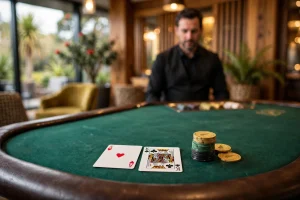
I find that distinction useful when deciding whether live baccarat suits me. If I want a hand to be over quickly, waiting through the dealer’s actions can feel like dead time. If I want the round to feel more like sitting at a table, that same pause is part of the appeal. Neither reaction says anything about the result. It is just a question of what you want the screen to feel like.
A specialist review has described live-casino play as comparatively dull because baccarat itself can move quickly. That is an opinion, not a rule about every table or every player. The pace can also vary by format: a specialist review gives Speed Baccarat rounds as lasting 27 seconds, compared with 48 seconds for standard rounds. Treat those figures as a reported comparison, not a promise that every live table will follow the same timing.
For real-money play, the extra pause matters in a practical way: you spend longer watching each round unfold, and the visual presence of a dealer can make the session feel more absorbing than it is. I have caught myself treating a more immersive screen as if it made the decisions more meaningful. It doesn’t. The dealer’s presence changes the presentation, not the basic nature of the wager.
Before joining a live table, I’d check whether the pace feels comfortable rather than assuming “live” means more exciting. If waiting through the deal irritates you, a faster format may suit your attention better; if you enjoy following the table, the slower rhythm may be the point. The key is not to let the atmosphere push you into staying longer or staking more than you intended. A real dealer is still a screen away.
New Zealand’s 2026 Online Casino Law—and What It Does Not Mean Yet
The Online Casino Gambling Act became law in May 2026, creating a new route for online casino gambling to be regulated in New Zealand. It is intended to regulate online casino sites and provide consumer protection. That is a meaningful change, but it is not the same as a licensed market already being open.
The Act took effect on 1 May 2026 and established a domestic licensing system. The timing matters: a law can set out how licensing will work before licences have actually been issued. Online casino licences are expected to be in place in early 2027. Until then, the phrase “regulated online casino” can sound further along than the timetable supports.
I would separate three things that are easy to blur together: the law being enacted, the licensing framework being created, and operators receiving licences under it. The first two have happened; the third is still expected in the future. So if you are looking for real-money baccarat in New Zealand in 2026, the new Act alone does not show that a domestic licensed online casino is already available.
That distinction is less exciting than a launch announcement. It is also the useful part. “New law” does not automatically mean a player can sign in to a locally licensed casino, or that every site using the language of regulation has a New Zealand licence. The expected early-2027 timing is a forecast for licences to be in place, not proof that they have already been granted.
For now, I would read claims about the new regime literally and check what stage they describe. Is the claim about the Act, the licensing system, or an actual licence? Those are different milestones. A headline that compresses them into “New Zealand’s online casinos are regulated” can leave you with the wrong impression if it skips the timing.
The change is real; the finished licensed market is not yet established by enactment alone. That is the point to keep in mind when a site or promotion invokes the 2026 law. Wait for the licence stage, rather than treating the passage of legislation as a green light.
Trying Baccarat Without Money: What Practice Can—and Can’t—Tell You
A no-money session can take the awkwardness out of your first few rounds. You can get used to the screen, see where the Player, Banker and Tie options appear, and follow when betting opens and closes without putting a stake down. If a baccarat game offers a practice mode, that is what it is good for: learning the interface and the basic shape of a round.
The aim is not to discover a pattern. In baccarat, you choose which outcome to back, and the hand closest to nine wins. Practice can help you remember that choice, but a run of results on screen does not tell you what will happen in a later round. I used to treat a streak as a clue. It wasn’t. It was just a streak, and I was giving it a story.
That is the line I’d keep in mind with baccarat online without money: it can teach familiarity, not foresight. A practice balance is not a bankroll, and results recorded in a free session do not build an advantage for when money is involved. Switching from practice to paid play changes what is at stake; it does not make your observations predictive.
Keep the session simple. Try each of the available bet choices, watch how the interface marks your selection, and check that you understand which hand won. If you find yourself clicking without knowing what you selected, pause and start again. There is no prize for rushing through a game you are still trying to understand.
Also notice how you react to a sequence of wins or losses, even when no money is on the line. I have caught myself wanting to “get it back” in a free game, which is a useful warning about how quickly habit can take over. But a practice session cannot reproduce the pressure of risking your own money, either. Free play may feel casual precisely because nothing is at stake.
Use it to learn the buttons. Then be honest about what it did not teach you. No prediction. No edge. Just a chance to get familiar before deciding whether to play at all.
What is the difference between Baccarat and Punto Banco?
Punto Banco is the most common baccarat variant and the standard version at online casinos. You bet on Player, Banker or Tie, but you do not control how either hand is played.
What online casino has baccarat?
Online casinos commonly offer Punto Banco, and baccarat is also available with a live dealer. New Zealand has no state-regulated online casinos, and licences for online casinos under its domestic system are not expected until 2027.
Is it legal to play baccarat in New Zealand?
Yes, it is not illegal for New Zealand players to play at international online casino sites. New Zealand-based companies are not allowed to offer online casino gambling, and domestic online casino licences are not expected until 2027.
Why is Banker the best bet in baccarat?
Banker has the lowest house edge of the main bets: 1.06%, compared with 1.24% for Player and 14.36% for Tie. Its winning payout is lower than Player’s, and the lower edge does not guarantee a win on any particular round.
Is baccarat a game of skill or luck?
Baccarat is mainly a game of luck: you choose which outcome to bet on, but you do not control the deal or the result. A past run of wins or losses does not reliably predict the next round.
Can I use a betting system in baccarat?
You can choose a staking system, but it cannot make the next result more predictable or remove the house edge. Set a limit you can afford to lose rather than increasing bets to recover losses.
Casino Games in New Zealand: Roulette, Blackjack & More
Content created by the «casinoslotnz.com» team