
Know What Changes When Blackjack Is Played for Cash
 Available in US
A practical look at real-money stakes, mobile play, rules, bankroll decisions, funding and live tables.

What Real-Money Blackjack Online Actually Involves
The first difference between a free game and blackjack played for cash is not the cards. It is what a decision can cost you. In a no-money version, the balance is there to keep score or let you learn the interface. In a real-money game, your stake comes from funds you can actually lose, and any winnings affect your balance too. Same-looking table. Different consequences.
I used to treat a free version as a rehearsal for the paid one. It helped me recognise the buttons, but it did not prepare me for how quickly I could start caring about every hand. Play money is easy to replace in your head. Cash is not. When you switch to real stakes, even a familiar decision can feel different because the result no longer stays inside the game.
Free blackjack can still be useful. You can get a feel for the pace, see how the controls work and practise following a round without putting money at risk. Some versions let you play with friends using virtual chips or simply keep score together. That can be a decent way to make a game social without turning it into a money matter. Just remember that a practice balance is not a pot you can withdraw, and a good run with pretend chips does not tell you what a real-money session will feel like.
What RNG blackjack does
Many online tables use a random number generator, or RNG. The software shuffles the virtual cards and produces the deal; there is no physical deck being handled on screen. You make your choices through the game interface, and the software moves the round along. The shuffle is software-based, but that does not mean the play is automatically effortless or that a result is due because previous hands went a certain way.
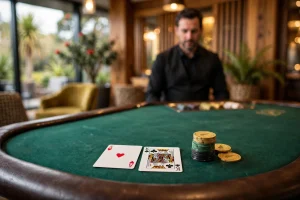
That distinction matters because online blackjack can move faster than a live-dealer game. There is no filmed dealer handling cards between each decision, so the round can proceed as soon as the required actions are made. I have found that speed can be a trap: fewer pauses make it easier to click through one hand and start the next without noticing how long you have been playing. Fast does not mean better. It means you need to be deliberate about when you stop.
Live play has a different feel because you watch a dealer conduct the round while you use the on-screen controls to act. It can feel more like sitting at a table, but the pace includes the dealer and the stream. RNG play is more direct and less dependent on a video feed. Neither format changes the basic fact that you are staking money when you choose a real-money table.
The money changes the experience
When you play online for real money, the balance displayed on screen represents funds at stake, not a score that can be reset without consequence. A win may increase it; a loss may reduce it. That sounds obvious, but the interface can make money feel abstract. Chips are smaller and cleaner-looking than notes or coins, and the next-hand button is always close by. I have made the mistake of treating that distance from physical cash as if it made the decision less real.
A sensible way to approach a real-money session is to decide what you are prepared to spend before opening a table, then treat that amount as entertainment money that may be lost. Don’t use a free-play streak as a reason to raise your stake, and don’t assume a losing run is about to correct itself. The result of one hand does not create a promise about the next one.
Promotional language deserves the same plain reading. A specialist review notes that bonuses may come with wagering rules and restrictions on which games count. So “extra money” may not mean cash you can use or withdraw without conditions. Read the offer’s terms before you build your plans around it.
Choosing between free and paid play
If your aim is to learn how an online table works, a no-money game lets you explore without risking funds. If you want the experience of a real stake, free play cannot reproduce that feeling—and it cannot demonstrate that you will make money. They serve different purposes. One is practice or entertainment without a cash wager; the other is gambling.
I would not call either option a shortcut. Free games can help you get comfortable with the format, while real-money games bring an actual financial downside. Keep those two things separate in your mind. The cards may look the same. The stakes don’t.
Blackjack Apps on Your Phone: What Changes
A phone makes blackjack easier to fit into a spare moment. It also makes it easier to start a session without thinking through where you are, how long you have, or whether the connection will hold. I’ve learned that the small screen is not just a smaller version of a desktop table. It changes how you pay attention.
A casino may offer a dedicated app, a mobile website, or both. The layout can differ: buttons may sit close together, the table may take up most of the display, and information that is obvious on a larger screen may be tucked behind a menu. Before you play for money, take a moment to find the balance display, the current stake and the controls. It is a dull check. Dull is good when money is involved.
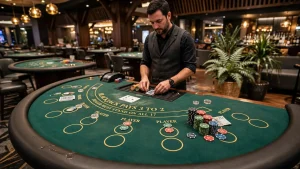
Touch controls reward deliberate taps. On a computer, a mouse click tends to feel separate from a scroll or a window change; on a phone, your thumb does all of it. If the interface is crowded, a quick tap can land on the wrong control or make you lose track of what you have selected. Slow down when the screen changes, especially after rotating the phone or opening a menu. Don’t assume a button is where it was a moment ago.
There is a useful difference between trying a free mode and playing for cash, even if the table looks identical. Free play can help you get used to the layout, but it does not put your own money at stake. Before switching modes, read the screen carefully: make sure you know whether the balance shown is practice credit or real funds. I once rushed past that sort of detail because the table itself looked familiar. Not my sharpest moment.
The phone also brings interruptions that are easy to underestimate. A message arrives, someone calls, or you need to move rooms. A live round may still be unfolding while your attention is elsewhere. If you have to step away, don’t leave a real-money session open and assume you can pick up exactly where you meant to. Finish what you are doing, or pause before starting another hand. A short break is cheaper than a distracted decision.
Live video asks more of the connection and the data plan than a simple screen of buttons and cards. A specialist review estimates live dealer play can use approximately 500MB to 1GB of data per hour. That is enough to make the choice between Wi-Fi and mobile data worth considering before you settle in. Streaming quality and the way a game is delivered can affect actual use, so treat that estimate as a planning guide rather than a promise for every session.
The practical test is not just whether the table loads. Notice whether the video keeps up, whether the controls respond cleanly, and whether you can read the on-screen information without leaning in or repeatedly changing the display. If the stream stutters, don’t try to compensate by tapping faster. Check that the connection has recovered and that the interface reflects what you intended before continuing.
A phone can also make a session feel more private than it is. That does not mean someone can see your screen; it means you may be playing in a shared space, on a device that other people use, or while notifications appear over the game. Think about who can see the display and whether you are comfortable with that before opening a real-money table. A quiet corner can help you focus. It cannot make a rushed session sensible.
The same convenience that makes mobile blackjack appealing can blur the line between “I have a moment” and “I’m now committed to playing.” I try to decide before opening the table whether I actually have time to pay attention. If not, I leave it for later. A phone is always close by, but that is not a reason to turn every idle stretch into a wager.

For a casual session, the best mobile setup is the one you can operate without squinting, rushing or fighting the connection. Get comfortable with the controls in a no-money mode if one is offered, then confirm the balance and stake before real play. Keep an eye on data when using live video, and give the game your attention while it is running. Small screen, real choices.
New Zealand’s 2026 Online Casino Rules and Your Play
For Kiwis, the key distinction is where an online casino is based. Online gambling is legal for players here when the casino itself is based outside New Zealand. The country has not allowed online casinos to operate from within its borders. That does not mean every overseas site has been locally licensed or supervised.
Before the new law, a casino serving New Zealand from overseas sat outside the oversight of a New Zealand regulator. If a customer had a dispute with one of those sites, there was no domestic government recourse. I’d once treated “available to play” as the same thing as “covered here”. It isn’t.
What changed in 2026
The Online Casino Gambling Act 2026 took effect on 1 May 2026, creating New Zealand’s first domestic licensing framework for online casino gambling. It sets a limit of up to 15 licences. The Department of Internal Affairs oversees the framework, while the Gambling Commission issues licences and approves changes to their conditions. Those are separate jobs: one body supervises the system, the other handles licensing decisions.
Department of Internal Affairs
Oversees the wider domestic licensing framework for online casino gambling.
Gambling Commission
Responsible for issuing licences and approving changes to their conditions.
The law does not mean that every site available to New Zealand players instantly became licensed. There is a transition period. Casinos that were already providing services to people here before the law began may continue operating until 1 December 2026 under the transitional provisions. The full licensed regime is not expected to be operating until 2027.
That makes the timing matter. A casino being accessible during the transition does not, on its own, show that it holds a New Zealand licence. Nor does the new framework mean that a licence can be assumed just because a site offers blackjack for real money to local customers. The move to a locally licensed market takes time.
What this means if you want to play
If you are considering online blackjack, keep three things distinct: whether the site is based in New Zealand, whether it is allowed to operate during the transition, and whether it holds a licence under the new regime. The first point determines whether the existing rule against domestic online casinos applies. The second relates to the transitional permission for providers already serving the country before the Act took effect. The third concerns the licensing system being established.
That is less tidy than a simple “legal” or “illegal” label, but it is the useful distinction. New Zealand players may gamble online with an offshore casino; the law does not make the player’s act a crime. The regulatory change is aimed at the providers and the conditions under which they can operate here. If a site is outside the New Zealand framework, do not assume local oversight or local government help if something goes wrong.

During the transition, casinos are also prohibited from advertising online casino gambling services to people in New Zealand. So a loud promotion is not proof of a local licence, and an offer framed as a reason to play should not be mistaken for regulatory information. I learned to separate sales language from the detail that actually affects my decision. Not the same thing.
As the licensing system comes into operation, the Gambling Commission’s role is especially relevant: it is responsible for granting online casino licences and approving changes to licence conditions. The Department of Internal Affairs oversees the wider framework. If you are checking a provider’s status, those functions are not interchangeable, and a general reference to regulation is not the same as evidence of a licence.
For now, the practical picture is a market moving from offshore provision without domestic supervision towards a New Zealand licensing regime. The transition has a defined end date for providers already operating here, while the full system is expected later. Keep those dates and roles in mind when deciding where to play; don’t read access as endorsement.
The Blackjack Rules You Need Before You Play
The aim is to finish with a hand closer to 21 than the dealer’s, without going over 21 yourself. You are not trying to match another player’s cards; each hand is judged against the dealer’s. That sounds simple, and the basic idea is. The details that matter are what happens after the first deal and which rules the table uses.
Do
- Check the dealer's soft-17 rule
- Verify the deck count
- Confirm if surrender is offered
Don't
- Rely on "feeling lucky"
- Assume all table versions are identical
- Ignore the game's help panel
At the start, each player receives two cards, and the dealer receives two as well. In many versions, one dealer card is visible while the other stays face down. That visible card gives you some information, but it does not tell you how the round will finish. You still have to decide what to do with your own hand.
The usual choices are to hit, stand, double down or split. Hitting means taking another card; standing means keeping the hand as it is. If you go over 21, you have gone past the target, so a strong-looking hand can still be a losing one. I used to treat every decision as a question of whether I “felt lucky”. That is a poor substitute for knowing what the buttons actually do.
Doubling down means increasing your wager and taking a further card under the table’s rules. Splitting is available when your first two cards form a pair: the hand is divided into two hands, each played separately. The details of what happens after a split can depend on the table, so do not assume every version handles it identically. Before you commit, check the rules displayed for that game.
Some tables also allow surrender. Where that option is available, you give up the hand and forfeit half of your bet rather than playing it through. It is not offered everywhere, and it is a separate choice from standing: standing keeps your hand in play, while surrender ends it. Small distinction. Real consequence.

The dealer follows fixed rules rather than choosing freely in the way you do. The dealer must draw until reaching a total of 17 or more, then stop. One detail to inspect is what happens on a soft 17, a dealer hand that can be treated differently by different tables. The wording may say that the dealer hits or stands on soft 17; that difference can affect the round.
Deck count is another rule worth checking. A game may use more than one deck, and the number of decks is part of the table’s stated conditions. Surrender availability matters too. These details do not change the aim of blackjack, but they do change the conditions under which you make your decisions.
When you play real-money blackjack, the interface can make the choices look self-explanatory. It is still worth reading the table rules before you start, rather than discovering a variation after placing a bet. Check the dealer’s soft-17 rule, the deck count, whether surrender is offered, and the options available after a split or double down. If a term is unclear, pause and look it up in the game’s help panel.
Once you know the deal and the available actions, a hand is easier to follow. You can see what is your decision, what is the dealer’s fixed procedure, and which details belong to that particular table. That is the foundation. The next question is what those decisions can—and cannot—do for your results.
Can You Make Money Playing Blackjack? The Uncomfortable Maths
You can win money in a blackjack session. That is not the same as making money from blackjack over time. I used to treat a run of winning hands as evidence that I had found a reliable way to earn. It was evidence of one thing: I had won those hands. The next session did not owe me a repeat.
The uncomfortable part is that blackjack gives the casino a mathematical advantage even when you play perfectly. Under a specific set of rules — eight decks, a 3:2 payout for a natural blackjack, the dealer standing on soft 17, doubling after a split, no surrender and resplitting up to four hands — the house edge with perfect basic strategy is approximately 0.43%. That is a long-run expectation, not a prediction of what will happen in your next session.
A small edge can be hard to feel. You might leave ahead after a short visit, or lose quickly; neither result proves that the underlying maths has changed. Across repeated play, the expected effect of the house edge is that the casino keeps a small advantage over the money wagered. It does not mean the house wins every hand, or that your results will follow a neat pattern. They will not.
And that figure depends on the rules. A table paying 6:5 for a natural blackjack instead of 3:2 increases the house edge by approximately 1.4%. That change is larger than the 0.43% edge in the favourable example above. So the phrase “blackjack has a low house edge” can hide a detail that matters: the payout and other table rules shape the maths. The headline alone is not enough.

This is why asking how much money you can make playing blackjack has no dependable answer. The result depends on the rules, your wagers, how long you play and the variation in the cards. You might finish ahead; you might lose the money you brought. There is no fixed income attached to a hand, a session or a lucky streak.
Online blackjack does not turn that uncertainty into a paycheque. A winning balance on the screen is still a result from play, not proof that you can repeat it whenever you want. I have made the mistake of counting a temporary win as money I had “earned”. It felt available, so I treated it as safe. That was wishful thinking dressed up as arithmetic.
There is also a difference between trying to make more money and changing the expected outcome. The 6:5 payout illustrates how a table can worsen the maths; a good run does not reverse it. A big win is possible, but the largest story someone tells is not a sensible forecast for your own results. Anecdotes select for the memorable night, not the many ordinary outcomes nobody posts about.
So, can you earn money playing blackjack? You can come away with a profit, but the game’s mathematics do not promise a lasting one. Keep those two ideas separate. The distinction matters.

How to Play Better Without Chasing Losses
I used to treat every blackjack decision as a fresh chance to “turn things around”. That sounds determined; in practice, it made me change my mind mid-hand and raise a bet because I disliked the last result. A better approach is less exciting: decide how you will play before the pressure arrives, then stick to those decisions.
Basic strategy gives you a consistent framework for choosing when to hit, stand, double down or split. Rather than relying on a hunch or on what happened in the previous hand, you compare your hand and the dealer’s visible card with a strategy chart for the table’s rules. The chart is a decision aid, not a prediction. It cannot tell you what the next card will be.
That detail matters. Blackjack rules differ between tables, so a chart that fits one set of rules may not fit another. Check that the guidance you use matches the game in front of you. If you are unsure what a move means, pause and learn it before staking real money. Guessing because the table is moving is how a simple decision becomes an expensive one.
I have also learned to separate playing well from winning. You can make a sound choice and still lose the hand. You can make a poor choice and still win. One result does not prove that your decision was right, and a losing run does not mean the game owes you a win. Basic strategy can help you make more consistent choices; it cannot guarantee a profit or recover money you have lost.

Set a spending limit before you start, and treat it as a boundary rather than a target you need to reach. If you hit it, stop. Don’t increase your stake to win your money back, and don’t keep playing simply because you feel due a better result. I’ve made that mistake. It didn’t make the next hand kinder.
Some tables allow surrender, which means giving up the hand and losing half the bet. Whether it is available is a table-rule detail, so it is worth checking before you play. The useful habit is not memorising a move in isolation; it is knowing what choices you have and following a plan that fits the game.
There is no reliable shortcut to make money betting on blackjack. Better decisions are within your control. The cards aren’t.
Choosing a Blackjack App Without Falling for the Hype
“Best” is a slippery label. For me, a blackjack app is worth considering when I can tell what I’m choosing before money is on the table: the game type, its rules, and the minimum stake. A polished screen can make a table feel more appealing without making its terms any better.
Start with the table information, not the graphics. Check whether the dealer hits or stands on soft 17, how many decks are used, and whether surrender is allowed. Those details can change the way a hand plays, so two tables carrying the same game name may not be equivalent. If the rules are buried or unclear, I don’t treat that as a small design flaw. I move on.
- Check if the dealer hits or stands on soft 17
- Verify the number of decks used
- Confirm if surrender is allowed
- Check the minimum stake for the specific table
Minimums matter just as much as the headline experience. One specialist review reports that RNG tables can offer minimum bets of NZ$0.50 or NZ$1, while live-dealer tables in its sample list minimums from NZ$5 to NZ$25. Treat those as reported examples, not a promise about every app or table. Check the actual stake shown before you join; a table that looks suitable may start above what you meant to risk.
If an app offers a no-money mode, use it to learn where the controls are and how the table displays its rules. But don’t mistake a practice session for a real-money test: it cannot show you how you’ll feel when a stake is on the line. I learned that one the hard way. Familiarity isn’t discipline.
Also be wary of labels that turn a choice into a supposed system. “Even money strategy” sounds neat, but a phrase in an app description does not explain the table’s rules or make a decision automatically right. Read what the option actually does before tapping it.
And is blackjack easy money? No. An app can make a game easy to access; that is not the same as making it easy to profit from. I’d rather pick a table whose rules and minimum I understand than chase a “best” badge or a bright promise. Less theatre. More checking.
House Money, Side Bets, and the Cost of a Tempting Extra
“House money” sounds like cash you can risk without caring. I’ve fallen for that framing. A bonus may appear beside your balance, but it is not automatically the same as money you deposited yourself: conditions can determine whether you can use it, what games it applies to, and what you must do before it becomes withdrawable.
A specialist review of casino bonuses notes that offers can carry wagering rules and game restrictions. So I read the terms before counting a promotion as part of my bankroll. If blackjack is excluded, or play contributes only under particular conditions, the headline offer tells you very little about what you can actually do with it. The small print matters more than the banner.
I also keep promotional funds separate in my head from my own money. That sounds obvious until a losing run starts, and the bonus balance makes another hand feel free. It isn’t. Whether the funds came from a promotion or your pocket, a bet can still disappear. Don’t raise your stake just because the screen makes the balance look larger.
Side bets are another tempting extra. The name alone doesn’t tell you what the bet pays, what rules apply, or whether it fits the table you’re playing. I check the table information rather than treating a colourful label as an explanation. If the terms are unclear, I leave it alone.
My rule is plain: decide what you are willing to spend before you sit down, and don’t let an offer quietly change that figure. Promotions can be useful when their conditions suit how you play; they are not a reason to wager more or to assume a displayed balance is ready to withdraw.
Not free money.
Real-Money Blackjack: Currency and Getting Funds In
Before you move money to a blackjack balance, check which currency the account uses. Many international online casinos accept New Zealand dollars, so your funds can stay in NZD rather than being converted for play. That avoids foreign exchange fees attached to playing in another currency, though it does not tell you whether a payment provider may charge its own fee. I used to see a familiar currency symbol and assume the whole transaction was straightforward. Not quite.
Payment options differ between casinos. Common methods include Visa and Mastercard credit cards, debit cards, e-wallets such as Skrill and Neteller, and bank transfers. Some services also accept PaysafeCard or POLi. Treat that as a menu to verify, not a promise that every method will appear for your account or suit every operator.
There is an important catch with cards: licensed operators must not accept credit cards. So a credit-card option you encounter should not be taken as a sign that the same option applies across the licensed market. Debit cards are a separate payment category, but you still need to check the cashier’s current terms before relying on one.
I now check three things before choosing a route: whether the account is denominated in NZD, whether the method is available to me, and whether the payment screen discloses any fees or conversion. Then I make sure the name and currency shown at confirmation match what I intended. Small checks, less confusion.
A deposit method also does not guarantee that withdrawals will use the same route or follow the same process; read the operator’s payment terms rather than guessing from the deposit page. If a transfer would leave your everyday budget tight, pause before sending it. Getting funds into an account is the easy part. Getting your money decisions right starts before you press confirm.
Live Blackjack for Real Money: Cards, Pace, and Trade-Offs
Choosing a real-money blackjack site in New Zealand means checking what is known about its licensing or payouts before you play. Use this list as a starting point for reviewing the details relevant to your choice.
-
BitStarz
- License
- Curaçao Gaming Authority, licence no. OGL/2024/165/0185
BitStarz lists a Curaçao Gaming Authority licence, no. OGL/2024/165/0185. Check the licensing details as you consider it for real-money blackjack.
-
Neospin
- License
- Tobique Gaming Commission, licence no. 0000064
Neospin lists a Tobique Gaming Commission licence, no. 0000064. This licensing information is a useful detail to review before playing.
-
Lamabet
- Payout speed
- 1-3 business days
Lamabet is listed with a payout speed of 1–3 business days. That gives you a stated timeframe to consider when assessing the site for real-money play.
-
Ricky Casino
- License
- Tobique Gaming Commission, licence no. 0000002
Ricky Casino lists a Tobique Gaming Commission licence, no. 0000002. You can use this information as part of your checks before playing.
-
7Bit Casino
- License
- Tobique Gaming Commission, licence no. 0000091
7Bit Casino lists a Tobique Gaming Commission licence, no. 0000091. Its stated licensing is a concrete detail to consider when reviewing the operator.
-
Play Grand
- License
- Malta Gaming Authority, licence no. MGA/B2C/370/2017
Play Grand lists a Malta Gaming Authority licence, no. MGA/B2C/370/2017. Review this licensing information as you consider the operator for blackjack.
-
N1 Casino
- License
- Malta Gaming Authority, licence no. MGA/B2C/394/2017
N1 Casino lists a Malta Gaming Authority licence, no. MGA/B2C/394/2017. This gives you a specific licensing detail to check before playing.
-
Wintino
- Payout speed
- 1-3 business days
Wintino is listed with a payout speed of 1–3 business days. You have a stated payout timeframe to factor into your review.
-
Zotabet
- License
- 07017519840
- Payout speed
- 1-3 business days
Zotabet lists the number 07017519840 and a payout speed of 1–3 business days. The stated payout timeframe is a practical detail to consider when reviewing the operator.
A live table puts a dealer on screen, handling actual cards while you use the casino’s interface to make the decisions available to you. The video and on-screen details let you follow the round as it happens. That human presence is the main appeal for me: it feels less like watching a result appear from software and more like sitting in on a real table.
The trade-off is pace. The dealer has to deal, wait for players to act and complete the round, so real-money live blackjack takes longer than RNG play. A specialist review estimates an RNG hand at 15 to 20 seconds and a live-dealer hand at 30 to 45 seconds. Those are estimates, not a promise about every table; delays in the stream can stretch the wait further. I’ve found that a pause feels longer when money is already on the table.
The cost of joining can differ too. Specialist reviews describe RNG minimums as low as NZ$0.50 or NZ$1, while live tables may set minimums from NZ$5 to NZ$25. Check the displayed table minimum before taking a seat rather than assuming every live game suits the same budget. Higher entry stakes can make a slow round feel more consequential.
Live play is not automatically the more authentic or better choice. You get cards dealt by a person and a visible table, but you also accept the timing of the stream and the dealer’s pace. RNG play is quicker; live play gives you a physical deal to follow. I used to treat the live setup as the “premium” option. That label tells you little about whether the pace or stake fits you.
If you want the dealer-led experience, make room for the slower rhythm and check the minimum first. If you want quick rounds, the live table may test your patience. Not a small detail.
Is playing live blackjack online legal in New Zealand?
Yes, you can legally gamble online in New Zealand provided the casino is based outside New Zealand.
Can I play online blackjack for real money on my phone in NZ?
Yes, you can play on a phone using a casino app or mobile website. Check that you have selected real-money play and understand the stake before you place a bet.
What is the difference between 3:2 and 6:5 blackjack?
The ratio is the payout for a natural blackjack relative to your bet: 3:2 pays more than 6:5. Switching from 3:2 to 6:5 increases the house edge by about 1.4%.
Does blackjack always pay 3:2?
No. Some tables pay 6:5 for a natural blackjack instead of 3:2.
What blackjack variant has the best odds?
The specified eight-deck game with 3:2 payouts, the dealer standing on soft 17, double after split, no surrender and resplitting to four hands has an approximately 0.43% house edge with perfect basic strategy.
Casino Games in New Zealand: Roulette, Blackjack & More
Content created by the «casinoslotnz.com» team