
Assess a bingo room before you start playing
 Available in US
Online bingo in New Zealand is offered through offshore-licensed rooms, where game formats and casino features can vary.
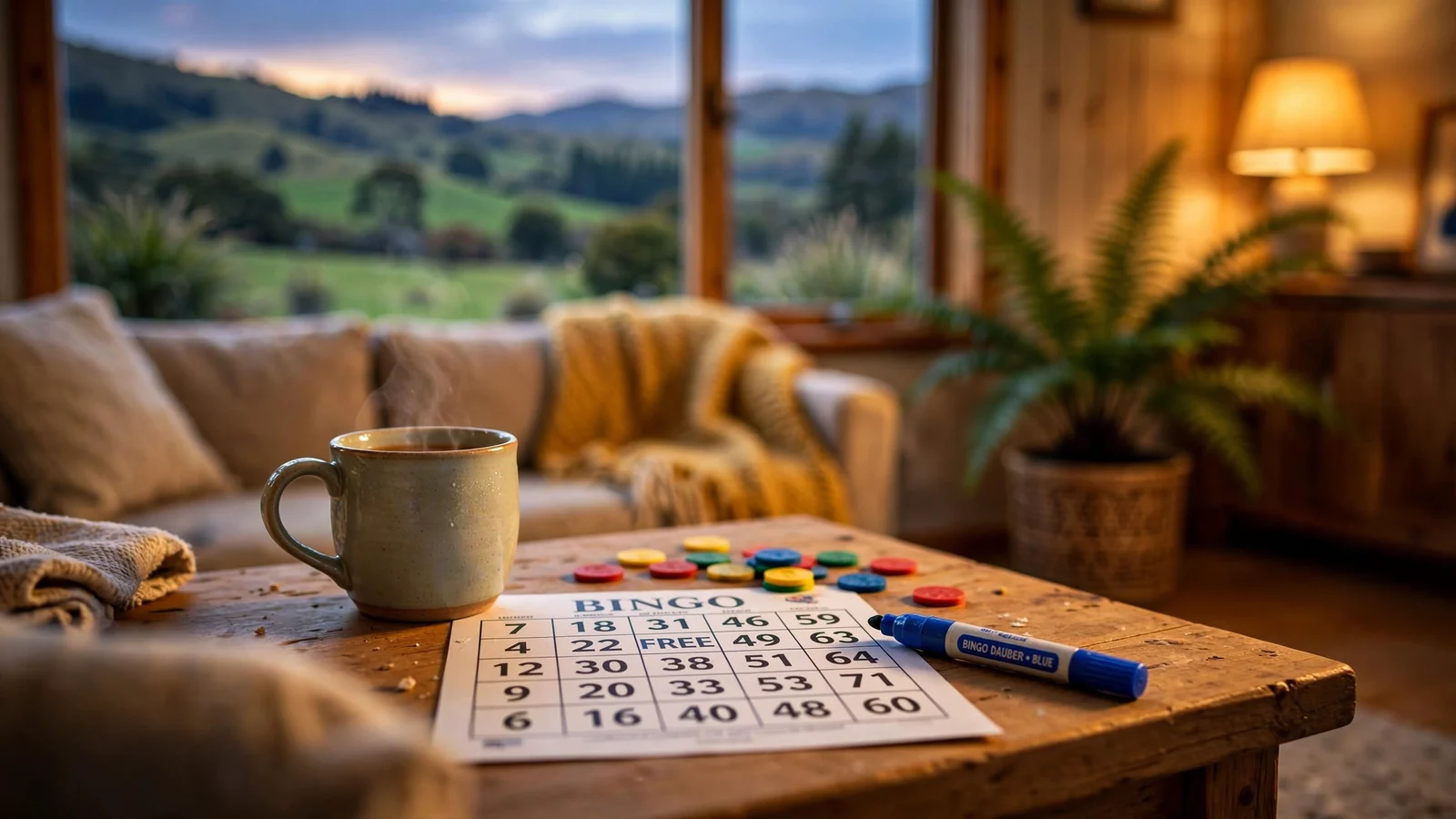
What Online Bingo Looks Like from New Zealand
From New Zealand, online bingo is something you reach through offshore-licensed rooms rather than a locally based online bingo hall. Those rooms make bingo available to players here and offer several kinds of play, including 75-ball, 90-ball and speed bingo. That is the useful starting point: “online bingo” is not one single game with one fixed pace or layout.
I’ve learned not to read a category label as a full description. A room may put bingo alongside other casino games, but the word on the menu does not tell you what a particular round will look like. The format matters. Before settling into a game, I look for its name and the short explanation beside it. If the page does not make clear which kind of bingo is on offer, I slow down rather than clicking through on the strength of a familiar label.
The three broad options give you different starting points. In 75-ball bingo, the number in the name signals a different format from 90-ball play; speed bingo is presented as its own faster category. Those labels are enough to tell you that the games are not interchangeable, even before you get into the card layouts, patterns or prize stages.
Use this shortlist as a starting point when exploring casino options for bingo in New Zealand in 2026. Check each operator's current bingo offering and availability before choosing, as the details provided here do not confirm them.
-
BitStarz
- License
- Curaçao Gaming Authority, licence no. OGL/2024/165/0185
BitStarz is listed with a Curaçao Gaming Authority licence, number OGL/2024/165/0185. The information provided does not specify its bingo offering.
-
Neospin
- License
- Tobique Gaming Commission, licence no. 0000064
Neospin is listed with a Tobique Gaming Commission licence, number 0000064. You’ll need to check its bingo offering separately, as it is not specified here.
-
Lamabet
- Payout speed
- 1-3 business days
Lamabet has a stated payout speed of 1–3 business days. No information is provided about its licence or bingo offering.
-
Ricky Casino
- License
- Tobique Gaming Commission, licence no. 0000002
Ricky Casino is listed with a Tobique Gaming Commission licence, number 0000002. The details provided do not establish whether it offers bingo.
-
7Bit Casino
- License
- Tobique Gaming Commission, licence no. 0000091
7Bit Casino is listed with a Tobique Gaming Commission licence, number 0000091. Its bingo offering is not specified in the available details.
-
Play Grand
- License
- Malta Gaming Authority, licence no. MGA/B2C/370/2017
Play Grand is listed with a Malta Gaming Authority licence, number MGA/B2C/370/2017. You’ll need to verify its bingo offering separately.
-
N1 Casino
- License
- Malta Gaming Authority, licence no. MGA/B2C/394/2017
N1 Casino is listed with a Malta Gaming Authority licence, number MGA/B2C/394/2017. No details are given here about its bingo offering.
-
Wintino
- Payout speed
- 1-3 business days
Wintino has a stated payout speed of 1–3 business days. The information provided does not specify its bingo offering or licence.
-
Zotabet
- License
- 07017519840
- Payout speed
- 1-3 business days
Zotabet has the listed identifier 07017519840 and a stated payout speed of 1–3 business days. Its bingo offering is not specified in the details provided.
A bingo casino online can therefore mean a room where bingo is one part of a wider gambling menu, rather than a place devoted to one style of bingo. From the player’s side, that can make the first visit feel less straightforward than expected. You may arrive looking for bingo and find several categories or game names to sort through. I used to treat that as a reason to pick the first familiar option. It is a poor shortcut. A quick check of the game description gives you a clearer idea of what you are opening.
There is also a difference between finding bingo online and deciding whether you want to play for money. The fact that a room offers online bingo does not, by itself, tell you what a particular game costs or whether a free-play option is available. Those are separate details to check on the game or room page. I try not to let a broad “play bingo” button fill in the blanks for me. It tells me where the game is, not what the session involves.

That distinction matters if you are browsing from a phone or dipping in for a short session. A title can sound familiar while the actual format is new to you. I would rather spend a moment confirming the game type than discover after joining that I had pictured a different sort of round. No drama, just an avoidable mismatch. The same habit helps when you move between rooms: look at the format named for the game, not only the general bingo heading.
The phrase “bingo casino online real money” can sound as if it describes one specific product. In practice, it points to a broad kind of access: bingo offered through an online casino room where real-money play may be part of the service. The words alone do not identify a particular format. If you are looking for 75-ball, 90-ball or speed bingo, those are the labels to pay attention to. If you are looking for a free option, check whether the room actually provides one instead of assuming that “online bingo” includes it.
For a first pass, I’d keep the search narrow in your own head: do you want a traditional-numbered format, a different card-and-pattern style, or a quicker game? The actual mechanics vary, so the room’s description is more useful than a flashy tile or a generic bingo banner. You do not need to understand every rule before browsing, but you should know what category you have chosen before treating it as the game you expected.

New Zealand players can find online bingo through offshore-licensed rooms, with 75-ball, 90-ball and speed bingo among the formats offered. That gives you a few distinct starting points, not one universal version of the game. I’ve found that keeping the labels straight is a small thing that saves confusion: first identify the kind of bingo, then decide whether that is the sort of session you meant to open. No guesswork needed.
How to Judge a Bingo Casino Without Falling for the Pitch
When I compare bingo rooms, I try to ignore the glossy language and start with the figures that affect a session. Ticket price tells you what each entry costs. Published return to player (RTP) gives you a broad indication of how a game is designed to pay back stakes over time. Neither number tells you what will happen in your next round.
That distinction matters. I have treated a bold percentage as if it were a promise, then watched a short session go the other way. It wasn’t a contradiction: RTP is a long-run measure, not a forecast for an individual player. “High return” is marketing shorthand, not a guarantee that you will win, or that a particular ticket is more likely to do so.
Start with the cost per ticket
A specialist affiliate review gives a price range of NZ$0.10–NZ$0.50 per ticket for 90-ball games in standard rooms, and reports that rounds last 3–7 minutes. Treat those figures as a snapshot from that kind of review, not as a universal price list. The room’s own game screen is the useful place to confirm the cost before you join.
I look at the ticket price before I look at the prize pool. A large advertised prize can pull your attention away from what you are spending to enter. Check whether the displayed cost is for one ticket or a bundle, and make sure you understand what the selection puts into the round. If you can’t tell what you’ll be charged, pause rather than guessing.

The comparison I care about is not simply “cheap versus expensive”. It is whether the entry cost makes sense for the session I intend to have. A lower ticket price can still add up if you keep joining rounds; a bigger prize headline does not change that arithmetic. I’ve learned that the hard way.
Read RTP as context, not a score
A specialist affiliate review reports published RTP figures between 85% and 92% for online bingo supplied by Pragmatic Play, Playtech and Microgaming. That range describes figures reported for those games and suppliers; it does not establish that every room offers the same games or publishes the same information. Check the particular game’s displayed rules or information panel, and see what the stated percentage actually applies to.
RTP is not the percentage of your stake that comes back in your own session. It is a theoretical return across play over time. So a room displaying a higher figure is not promising that you will leave with more money, and a lower figure does not tell you what the next round will pay. A percentage without a clear link to the game is hard to use.
I also avoid treating a published RTP as a league table. The headline number is only one part of the picture, and a difference between two figures cannot tell you whether the room suits your budget, how the game’s prizes are structured, or whether you will enjoy playing there. Those are separate questions.
Do
- Check the ticket price before the prize pool
- Read RTP as a long-run theoretical measure
- Verify figures on the game's information panel
Don't
- Treat high RTP as a win guarantee
- Assume a large prize outweighs the entry cost
- Use published RTP as a league table for rooms
Compare like with like
Before deciding that one room looks better, make sure you are comparing the same kind of game and the same basis for the figures. Ticket prices only help when you know what each price buys. RTP figures only help when they refer to the games you are actually considering. If either detail is buried, unclear or missing from the game information, the sales copy cannot fill the gap.
I keep the check simple: find the cost before entering, read the available RTP information, and decide on a spending limit before the session starts. Then I treat the numbers as information, not encouragement to play longer. A page can call something the “best online bingo casino”; that label is not a measurement. The useful details are the ones you can verify before you spend.
The Bingo Formats You’ll Actually Encounter
The main difference between bingo formats is what your ticket looks like and what counts as a win. Some games reward lines as numbers are called; others set a pattern in advance. Once you know which version is on screen, the prize stages make more sense. The names can sound interchangeable. The cards aren’t.
75-ball and five-line bingo
North American 75-ball bingo uses a five-by-five card, with a number in each of its 25 squares. Rather than advancing through a fixed sequence of line prizes, a round can award wins for completing a pattern. That might be a letter, a shape, or a blackout, where every square on the card is covered.

Five-line bingo also draws from numbers 1 to 75 and uses a five-by-five card with 25 numbered squares. There is no free centre square. Its defining feature is the progression of prize stages: a completed line, then two, then three, four and finally five. Five completed lines is the full house.
That progression gives each round a different rhythm from a pattern game. You may be looking for the first line early on, while later stages depend on filling more of the same card. Check the game’s stated winning lines: in a room that counts horizontal rows, each completed row is a line. A row with several marked numbers is not an extra line by itself.
I used to assume every 75-ball game meant the same thing. It doesn’t. The number range can match while the win conditions differ. Read the pattern or prize-stage description, not just the ball count.
90-ball bingo
A 90-ball ticket is arranged as a three-row, nine-column grid and contains fifteen numbers. The familiar prize steps are one completed line, two completed lines and a full house. In other words, the round builds from a partial win toward covering every number on the ticket.
That makes its progression easy to recognise, but the details still matter: the game rules tell you what counts as a line and how the stages are awarded. The format is not the same as five-line bingo, even though both can reward lines along the way. With five-line bingo, the stages climb through five lines; with 90-ball, the listed milestones are one line, two lines and the full house.
75-ball Bingo
Uses a five-by-five card; wins are based on specific patterns (shapes, letters) or blackouts.
Five-line Bingo
Uses a five-by-five card; prizes progress through completing one, two, three, four, and five lines.
90-ball Bingo
Uses a three-row, nine-column grid; milestones include one line, two lines, and a full house.
80-ball bingo
The 80-ball version changes both the card and the way wins are shaped. Its ticket has sixteen numbers, and its pattern choices differ from the line-and-full-house progression associated with 90-ball games. So if you are used to watching for rows, do not assume that a row is the target here.
The useful thing to look for is the pattern shown in the round’s rules. The card may look more compact, but appearance alone does not tell you which squares need to be marked. I’ve learned that the hard way: a quick glance at a ticket is no substitute for knowing the target.
Speed bingo
Speed bingo strips the ticket down to a three-by-three card and has a single full-house prize. There are no listed intermediate line stages to follow. The aim is to cover the whole card, so the round’s central question is simply whether all its numbers are called before another ticket completes the target.
That makes speed bingo mechanically straightforward, though the pace can make it easy to lose track if you are juggling several cards. The format is distinct from 75-ball pattern games and from 90-ball’s staged line prizes. Small card, one target.
Across all these bingo casino games, the label tells you only part of the story. Check the card layout, the winning pattern and the prize stages before a round begins. That is enough to tell whether an online bingo casino game is built around lines, patterns or a full-house finish—without treating every version as the same game.

Bingo Bonuses: Read the Wagering Terms First
A welcome match can look simple: you deposit, the casino adds a matching amount, and your balance appears larger. The catch is that bonus money is rarely the same as cash you can withdraw straight away. Before accepting a bingo promotion, I now look for the conditions that control when it becomes withdrawable. The headline is only the start.
A specialist review describes a typical welcome deal for Kiwi players as a 100% match on a first deposit, with a ceiling of roughly NZ$300 in equivalent value. That is a description of the kind of offer, not a promise that every casino has one or that it is available now. The amount, eligibility and wording can change, so read the offer shown to you rather than relying on an old banner or a general description.
The first thing I check is the wagering requirement. A specialist review puts bingo bonus requirements in the 3x–10x range of the bonus amount. Treat that as a reported range, not a fixed market rule: the terms attached to an individual offer are what count. If the requirement says the bonus must be wagered several times, that means qualifying play must add up to the stated multiple before the bonus-related balance can be released. It does not mean you can simply withdraw the bonus after accepting it.
- Confirm the wagering requirement multiple (e.g., 3x–10x)
- Check if bingo play counts towards the requirement
- Note any contribution rules for different ticket types
- Verify expiry dates and maximum stake limits
- Review withdrawal conditions for bonus-related balances
The reference amount matters. Check whether the multiple applies to the bonus alone or is calculated another way, and whether the casino defines a separate target for winnings. If the wording is unclear, pause rather than assuming the friendliest interpretation. I have made that mistake: I saw “matched” and mentally treated the extra funds as mine. They were not. Small print, big difference.
What to check before opting in
Read the promotion’s terms alongside the cashier and account rules. Look for:
- Qualifying games: Confirm whether bingo play counts towards the requirement and whether every game or ticket type is eligible. A bonus described as suitable for bingo is not proof that all bingo play contributes.
- Contribution rules: If the terms assign different contributions to different games, note how that affects progress. Do not assume a round advances the target in the same way as another kind of play.
- Expiry and limits: Check whether the offer has a time limit, a maximum stake while wagering, or a cap on eligible winnings. These details can change how usable the promotion is.
- Withdrawal conditions: Find out what happens to the bonus and any associated winnings if you cash out early or fail to meet the requirement.
- Eligibility: Check whether the offer is for new customers, requires a qualifying deposit, or needs to be activated before play.
Those are not reasons to assume a promotion is bad. They are the parts that tell you what you are actually agreeing to. If a term is missing or hard to interpret, do not fill the gap with the most convenient guess.
A “no deposit” bingo offer means a promotion presented without requiring an initial deposit to claim it. That phrase can sound like free, unrestricted play, but it does not tell you whether an offer is available, who qualifies, what wagering applies, or whether a later deposit is needed before withdrawal. Check the specific terms before treating any no-deposit bonus as usable value. The label alone settles none of that.
I also separate a bonus from my own session budget. A matched balance can make it tempting to buy more tickets because the displayed total looks generous. But wagering conditions may mean you need to keep playing before any eligible winnings can be withdrawn. If the offer would push you into spending more than you intended, declining it is a perfectly sensible choice. No bonus is owed to you.
My rule is boring, which is why it works: understand the requirement first, then decide whether the promotion fits the way you planned to play. If the terms do not make sense, leave it alone. The banner can wait.
When a Casino Calls Itself a Bingo Casino
“Bingo casino” sounds like a clear description, but it can mean something narrower than the label suggests. It points to bingo as one part of a casino’s offering; it does not tell you that bingo is the main attraction, or that every site using the label has the same selection.

I used to treat a category name as a promise. That was an easy way to expect one thing and land somewhere else. A casino can group bingo alongside its other gaming sections, while the amount of attention devoted to it varies. The label alone won’t tell you how prominent the section is, how easy it is to find, or what’s available once you open it.
That distinction matters because “bingo” is a product category, not a complete description of the room. The games and formats are their own question; the category name doesn’t settle it. Nor does it mean that a site built around casino games has become a specialist bingo room just by adding a bingo heading to its menu.
There’s also a regulatory point that’s easy to miss. Bingo sits within the same broad licensing framework as the casino’s other gaming categories. It isn’t automatically a separate kind of operation just because the games look different from slots or table games. So the label tells you something about the product grouping, but not, by itself, what regulatory status applies to a particular provider.
When I’m trying to understand what a site means by the term, I look at how it presents the category rather than relying on the front-page wording. Is bingo a distinct section, or just a mention in promotional copy? Can you see what the section contains before you make an account? Does the description explain the offering plainly, or lean on a broad “bingo” badge and leave you to fill in the gaps?

Those are basic checks, not proof that a site is suitable. A polished menu can still be vague, and a big label can sit over a small or changing selection. I’ve learned not to confuse visibility with substance.
The same goes for descriptions such as “bingo-focused” or “bingo-friendly”. They sound specific, but they may describe emphasis rather than a guaranteed range of games or services. Read them as positioning, then look for the actual details. If those details aren’t easy to find, the label hasn’t answered much.
In short, bingo casinos aren’t a single standard type of site. The phrase can describe a casino that includes bingo among its verticals, while the actual weight and shape of that offering depend on the individual room. The category is a starting point, not a promise. A label is not the whole story.
How to Play a Round Without Losing Track
Before a round starts, check what the room counts as a winning line and which prize stages are active. “Easy to follow” can mean the software marks numbers for you; it does not mean every pattern on screen qualifies. I’ve found it helps to know the rule before the calls begin, rather than trying to decode it after a result appears.
A line is judged on an individual ticket. If you have several cards in play, completed lines on separate cards do not add up to the required result. Keep each ticket’s progress separate. A card that is one mark short of a line does not borrow a marked number from another card, however close the two look side by side.
The counting rule matters, too. In a room where a line means a completed horizontal row, two completed rows count as two lines. A different row with three marked numbers is still incomplete; those marks do not make a third line. That distinction can feel fussy while the calls are moving, but it is exactly where a quick glance can fool you.
Follow the prize stages shown for that round. A ticket may qualify at more than one stage if the room’s rules allow it, so do not assume that reaching one stage removes it from consideration for another. The reverse is also worth remembering: qualifying does not necessarily mean one ticket gets the whole prize. If several tickets are eligible, they may share it.
When automatic marking is available, the system tracks called numbers against your ticket and identifies eligible results. That takes the pressure off scanning every square in real time, but I still check the ticket and the displayed result. Automatic marking is a helper, not a reason to skip the rules. Confirm that the ticket is active, see which pattern or line the room is counting, and read how it handles ties or shared prizes.
If you are figuring out how to play casino bingo for money, start with one ticket and watch a full round before adding more. That is not a trick for improving the odds; it is a way to learn the interface without juggling cards. Check the marked numbers, compare them with the stated pattern, and wait for the room to show whether a prize stage has been reached. If the result is unclear, open the round rules or account history before moving on.

It is easy to lose track when calls come quickly and several cards sit together. I’ve made that mistake: I saw a promising pattern across the screen and treated it as one result. It wasn’t. Keep your eyes on one ticket at a time, and let the room’s written rules—not the visual impression—settle what counts.
What New Zealand’s 2026 Licensing Transition Means
The change is from offshore online casino gambling without New Zealand oversight to a domestic licensing system. The Department of Internal Affairs (DIA) is the country’s primary gambling regulator, and it is responsible for putting the new framework into operation. Bingo sits within the wider online casino licensing umbrella, rather than having a separate licensing track.
The Online Casino Gambling Act 2026 took effect on 1 May 2026. It created a transition period that runs until 1 December 2026. During that window, providers already serving customers in New Zealand before the Act took effect may continue operating under the transitional provisions. That is a temporary bridge, not the finished licensing system.
The deadline matters to providers: those that have not applied for a licence must stop providing online casino gambling in New Zealand by 1 December 2026. If an application is declined, the provider must leave the market and cease those operations. The Act establishes the country’s first domestic licensing regime for online casino gaming, while the full system is not expected to be operational until 2027.
The DIA describes the rollout as staged and expects the regime to be fully operational in 2027. That means the transition and the final licensing framework are not the same thing. A room operating during the transitional period should not be described as New Zealand-licensed merely because it is allowed to continue temporarily.
A specialist review describes the proposed licensing framework as allowing up to 15 online casino licences. That figure is a reported feature of the proposal, not a guarantee that a particular bingo room will receive a licence or remain available. The practical point is that the licensing process concerns providers and their broader casino services; bingo is one part of that product range. Long-term status depends on the provider’s application and the regulator’s decision. No instant switch.
There is also a wider change in the consequences for providers. The new framework sets a path toward licensed operation, while unlicensed operation is expected to become an offence around mid-2027. For players looking at a casino that includes bingo, the transition is therefore about how the provider is authorised over time, not a new bingo format or a change to how a round is played.
Getting Money In and Out: Banking Changes for Kiwi Players
For years, POLi let New Zealand customers pay straight from a bank account, and it became a familiar way to fund casino deposits. A specialist casino-payment review reports that the service was discontinued in 2024. If you still expect to see it at the cashier, that old routine has changed.

The alternatives described in a specialist review include Worldline and Blink, direct bank transfers from ASB, ANZ, BNZ and Westpac, Visa or Mastercard debit cards, and e-wallets such as Skrill, Neteller and MuchBetter. That is a menu of methods used by New Zealand players, not a promise that every bingo casino site offers each one. The cashier is the useful place to check: available options can differ from one operator to another.
I used to treat a familiar payment logo as proof that a deposit would be straightforward. It only tells you that a method is listed; it does not answer whether your account, card or bank transfer will be accepted. Check the cashier before deciding how you will fund an account, and read the method’s instructions rather than assuming every bank payment works the same way.
Also check the direction of the transaction. A payment method shown for deposits may not be available for withdrawals, so look at the cash-out options as well before you put money in. If the operator explains its processing steps, read those too; the payment name alone does not tell you how a withdrawal is handled.
Keep the details consistent. Use payment information that belongs to you, and follow the cashier’s own steps carefully. If a method is unavailable or a transaction is declined, avoid repeatedly trying different routes without checking the operator’s instructions first.
The practical point is simple: POLi is no longer an option, and other methods are in use, but there is no single cashier shared by every site. Check what is actually displayed for your account before depositing. No assumptions.
Available payment alternatives
New Zealand players can use Worldline, Blink, direct bank transfers (ASB, ANZ, BNZ, Westpac), Visa or Mastercard debit cards, and e-wallets like Skrill, Neteller, and MuchBetter.
Bingo Plus Casino: What the Combination Really Means
I used to read “bingo plus casino” as if the word *plus* promised some special combined game. It usually tells you something simpler: bingo and casino games are being presented as different parts of a wider online gambling product. The label describes a mix of categories, not a new set of bingo rules or a guarantee that every category will be available to every player.
That distinction matters. A provider may group bingo alongside other casino verticals, but the label alone does not tell you what is actually offered, how the sections are arranged, or whether they can be used together in a particular way. I no longer assume that “all in one” means one seamless experience. It may just be a convenient heading.
There is also a regulatory point behind the pairing. Bingo products sit under the same licensing umbrella as other casino verticals. In other words, bingo is not automatically a separate kind of service simply because it has its own lobby or is highlighted in a casino’s name. The product category and the licensing framework are related, even when the site presents them as distinct activities.
That does not mean a shared label tells you the status of any particular provider, or that a specific bingo room is available alongside casino games. It is not proof of a licence, a promise of access, or a description of the games on offer. The words on a page can be broader than the actual product.
So when you see bingo paired with casino, read it as a description of the provider’s intended range, not as a guarantee about what you will find after opening an account. I’ve learned to treat the label as a starting point, not a feature list. Marketing shorthand. Nothing more.
Playing Casino Bingo in NZ: The Legal Position
For New Zealand residents, playing bingo through an offshore online room is not prohibited under the Gambling Act 2003. The key distinction is between the player and the provider: the law’s position on a resident joining an offshore site is not the same as the rules governing where an online casino may be based or how it may operate.
In practical terms, an adult in New Zealand can access offshore online casinos and bingo sites. The stated age threshold is 18 or over. That applies whether you are looking for a bingo room on its own or bingo within a broader casino offering; the product label does not change the basic position for the player.
I used to read “legal” as if it meant the government had checked every part of the experience for me. That is too generous an interpretation. It means the resident is not prohibited from playing; it does not, by itself, tell you how a particular room handles disputes, accounts or payments. Keep those questions separate from whether you are allowed to take part.
There is another useful distinction: an offshore room may be licensed in its own jurisdiction, but that does not make it locally licensed in New Zealand. Nor does the player’s ability to use an offshore site establish that the provider has a New Zealand licence. Those are different legal questions, and mixing them up can make a site’s wording sound more reassuring than it is.
So, if you are an adult resident considering casino bingo in New Zealand, the player-side answer is straightforward: playing at an offshore online bingo room is not prohibited under the stated law. The age threshold is 18. That is the narrow point to take from it—not a promise that every site is equally reliable, or that every claim on a site deserves your trust. My old mistake was treating permission as endorsement. They are not the same thing.
Is online bingo legal for players in New Zealand?
Yes. Adults aged 18 or over can play at offshore-licensed bingo rooms; playing there is not prohibited for New Zealand residents under the Gambling Act 2003.
Are online casinos licensed in New Zealand in 2026?
Online bingo and casino rooms available to New Zealand players are offshore-licensed. New Zealand’s new licensing regime is being introduced in stages and is expected to be fully operational in 2027.
Can I play online bingo for real money in NZ?
Yes. You can access real-money bingo through offshore-licensed rooms, including 75-ball, 90-ball and speed bingo.
What RTP should I expect from online bingo games?
Published RTPs for online bingo in rooms supplied by Pragmatic Play, Playtech and Microgaming generally range from 85% to 92%. RTP is a long-run measure, not a promise of what you will win in a session.
How do I deposit at an NZ bingo site after POLi closed?
You can use Worldline, Blink, direct bank transfer from ASB, ANZ, BNZ or Westpac, Visa or Mastercard debit, or e-wallets such as Skrill, Neteller and MuchBetter.
Casino Games in New Zealand: Roulette, Blackjack & More
Content created by the «casinoslotnz.com» team