
Know What to Check Before Taking a Seat
 Available in US
A practical guide to table layout, rule variations, betting decisions, card charts and the differences between live and electronic play.
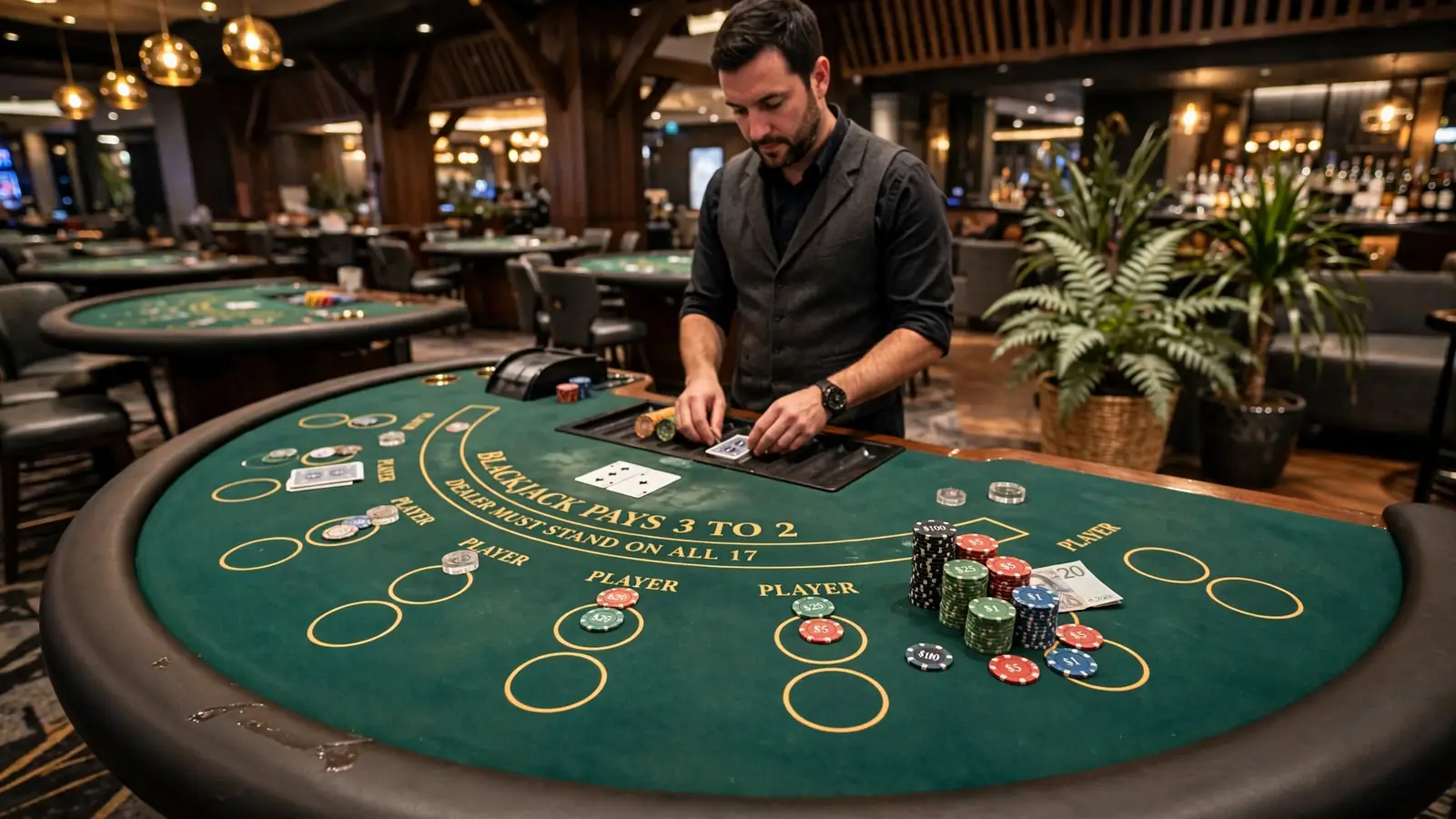
What a Blackjack Table Actually Looks Like
A blackjack table is easier to understand once you picture the people around it, not just the green felt. The dealer sits or stands behind the curved edge, with a clear playing area in front of them. Players take places along the opposite side. Each has a marked position for cards and bets, while the dealer has a separate space of their own. The layout keeps everyone’s part of the game visible.
The familiar green surface is practical, not mysterious. It gives the cards a clear background and helps define where each player’s area begins. You’ll see printed markings across the felt, but the details can differ from one table to another. The main impression is of a shared space: several players facing one dealer, with the centre of attention moving from one hand to the next.
A blackjack table at a casino can feel more social than the name suggests. Players sit near one another, but they are not playing against each other. Everyone is playing against the dealer. That distinction is easy to miss when you first walk up, especially if you’re trying to work out where to look. I used to watch the other players’ hands as if they were competing with mine. They weren’t. The dealer is the focus.
The physical table and the live game
At a land-based table, the cards are right there: the dealer handles them, players can see them, and the action happens in front of you. There’s no need to imagine what a digital animation might be doing behind the screen. A live-dealer game online keeps that physical element. It uses actual cards and a real dealer, with a camera showing the table to players watching remotely.
That’s why a live blackjack table can feel close to sitting in a casino, even when you’re at home. You see the dealer and the cards through a video stream, and the table itself remains the centre of the game. The screen gives you a view rather than turning the cards into software graphics. It is still a remote experience, though. Streaming can introduce a delay, and some live tables may require higher bets than a player expects. The atmosphere may travel through the screen; the timing isn’t always immediate.

The camera angle matters more than I thought it would. A useful view lets you follow what the dealer is doing and see the cards clearly. If the shot is awkward or the video pauses, you can lose the thread for a moment. That does not change the physical game taking place in the studio, but it does affect how comfortably you can follow it from your screen.
In person, you can take in the whole table at once: the dealer, the felt, the other players and the cards. Online, the frame chooses what you see. A live feed can bring the dealer close, but it can also make the table feel narrower than it is. I find that difference more noticeable than any animated graphics. Real cards, shown through a camera, still aren’t quite the same as being across the felt.
The online table on your screen
An online casino table is usually presented as a digital interface around the game. In a live-dealer version, the video occupies the main view, with controls and information arranged around it. The layout varies, so it’s worth taking a moment to see where the dealer, cards and your own playing area appear before settling in. A busy screen can make a simple table feel complicated at first glance.
A 21 blackjack table may look different from another table even when the basic scene is familiar. The felt design, camera framing and way the player positions are shown can change. Some screens make the table look wide and traditional; others use a tighter view suited to a phone. The visual style is not the game itself. It is just the way that particular table is presented.
Player count can affect the feel, too. In a physical casino, other people’s presence is part of the room: you hear conversation, notice someone arriving or leaving, and share the dealer’s attention. Online, the other players may appear as small boxes or indicators around the video. Sometimes the screen makes the table feel busy; sometimes it feels almost private. Neither view tells you that the game is against those players. You are still facing the dealer.
Do
- Check the dealer's view and card visibility
- Use free tables to learn the layout
- Prioritize a plain, readable layout
Don't
- Assume polished screens are easier to follow
- Rush into a game without checking the interface
- Let flashy graphics distract from the game
Getting comfortable at the table
When I’m looking at an unfamiliar blackjack table, I start with the view rather than trying to decode every marking. Can I see the dealer? Are the cards easy to follow? Is the player area obvious? Those are small checks, but they stop me from feeling rushed while I’m still figuring out the interface.
A free casino blackjack table can be useful as a way to look around without putting money into the game, if that option is offered. Treat it as a chance to learn the layout, not as a preview of every condition you might find elsewhere. The table’s appearance can tell you where the action happens; it doesn’t tell the whole story.
The best-looking table is not necessarily the easiest one for you to follow. I’ve been drawn to polished screens and then realised the camera view made the cards harder to see. A plain layout with a clear dealer view can be more comfortable. Nothing flashy. Just a table you can read.
The Rules That Change the Game—and the Payout
Blackjack looks simple until you sit down and discover that two tables with the same name may not play by the same terms. The aim stays familiar: finish closer to 21 than the dealer without going over. But the rules printed for that game shape what you can do and what a win pays. I’ve learned not to treat the felt and a familiar layout as the whole story.

The first thing I check is the rules panel, not the artwork. It should tell you how many decks are used, what happens when the dealer has a soft 17, which player options are allowed, and how a natural blackjack is paid. Those details can differ from game to game, so “standard rules” is not much use unless you know what a particular table means by standard.
A natural blackjack is not just any 21
A natural blackjack is the opening two-card combination of an ace and a ten-value card. It is distinct from making 21 with more cards, and the payout can reflect that distinction. A specialist review describes the familiar natural-blackjack payout as 3:2, while noting that some tables offer 6:5 instead. That difference matters: the posted payout is part of the game, not a decorative detail.
Read the wording carefully. A game may describe its payout in a rules panel or table information screen, and it is worth opening that panel before you commit. I’ve made the lazy assumption that a blackjack pays the same everywhere. It doesn’t. A small-looking line of text can change the return on a winning natural, even though the cards and the objective look unchanged.
Dealer rules change the shape of a hand
Soft 17 is a hand containing an ace counted as 11 that totals 17 without busting. The table rules say whether the dealer hits or stands on that hand. It is easy to skim past that line because it sounds like a minor procedural detail. It is not: it changes how the dealer continues, and that affects the conditions under which your hand is competing.
The deck count also varies between games. So can surrender rules and the blackjack payout. These are not details you can safely infer from a casino’s general description of blackjack; check the rules for the specific game you are considering. If the information is tucked behind an icon, open it. If the screen is unclear, pause rather than guessing. Boring, but useful.
Surrender, when offered, lets you give up a hand under the conditions set by the table rather than continue playing it. It is not available everywhere, and the exact terms belong to that game’s rules. The same goes for doubling down and splitting. Their availability and restrictions can vary, so a hand you have played one way at another table may not offer the same options here.
The choices you may be offered
During a hand, the basic choices are to hit, stand, double down or split; some games also allow surrender. Hitting asks for another card, while standing ends your turn with the total you have. Doubling down and splitting are separate options governed by the table rules. You do not need to memorise every possible restriction before opening a game, but you do need to notice what the current table permits before acting.
That matters if you are looking for a blackjack game with no double down. The phrase is not a payout category or a special kind of win; it describes a restriction on one of the player’s options. Check the rules panel to see whether doubling is absent or limited. Don’t assume that a familiar-looking game will give you the same choice as another version.
The clearest table guide is the one attached to the game itself. Look for the dealer’s soft-17 rule, the natural-blackjack payout, deck information, surrender terms and any restrictions on player actions. I used to glance at the table, see cards and a dealer, and start. That was enough to miss the part that mattered most to the hand I was about to play. Read first. Then sit down.
Online Blackjack in New Zealand: What 2026 Changes Mean
Choosing a blackjack table in New Zealand means finding an option that suits what you value, whether that is licensing information or payout speed. Use these details as a starting point when reviewing the available choices.
-
BitStarz
- License
- Curaçao Gaming Authority, licence no. OGL/2024/165/0185
BitStarz lists a Curaçao Gaming Authority licence, numbered OGL/2024/165/0185. This gives you a specific licensing detail to consider when evaluating its blackjack tables.
-
Neospin
- License
- Tobique Gaming Commission, licence no. 0000064
Neospin lists a Tobique Gaming Commission licence, numbered 0000064. You can use this stated licence information as part of your review.
-
Lamabet
- Payout speed
- 1-3 business days
Lamabet’s stated payout speed is 1–3 business days. This is a useful detail for you to consider alongside its blackjack offering.
-
Ricky Casino
- License
- Tobique Gaming Commission, licence no. 0000002
Ricky Casino lists a Tobique Gaming Commission licence, numbered 0000002. The licence detail provides a specific point for you to check as you assess the operator.
-
7Bit Casino
- License
- Tobique Gaming Commission, licence no. 0000091
7Bit Casino lists a Tobique Gaming Commission licence, numbered 0000091. You can factor this licensing information into your review of its blackjack tables.
-
Play Grand
- License
- Malta Gaming Authority, licence no. MGA/B2C/370/2017
Play Grand lists a Malta Gaming Authority licence, numbered MGA/B2C/370/2017. This gives you a stated licensing detail to consider.
-
N1 Casino
- License
- Malta Gaming Authority, licence no. MGA/B2C/394/2017
N1 Casino lists a Malta Gaming Authority licence, numbered MGA/B2C/394/2017. You can use this specific licence information when reviewing the operator.
-
Wintino
- Payout speed
- 1-3 business days
Wintino’s stated payout speed is 1–3 business days. This may help you assess whether its payment timing suits your preferences.
-
Zotabet
- License
- 07017519840
- Payout speed
- 1-3 business days
Zotabet lists licence number 07017519840 and a payout speed of 1–3 business days. These details give you concrete points to consider when assessing the operator.
The legal backdrop for an online blackjack table in New Zealand shifted in 2026. For years, online casinos could not be based domestically under the Gambling Act 2003. Offshore sites were accessible to local players, but they were not licensed or supervised by a New Zealand regulator, and customers had no domestic government recourse if something went wrong. That distinction matters: access to a website did not mean it operated under New Zealand oversight.
The Online Casino Gambling Act 2026 creates the country’s first domestic licensing system for online casino gambling. It took effect on 1 May 2026, but the new framework is being introduced in stages. During the transition, only providers that were already serving people in New Zealand before that date may continue, subject to the Act’s transitional provisions. That permission is temporary, not a sign that the full licensing regime is already up and running.
The transition runs from 1 May to 1 December 2026. Existing providers may continue until the latter date while the changeover takes place. Providers that have not applied for a licence must stop offering online casino gambling in New Zealand by then; if an application is declined, the provider must leave the market. The full licensed system is not expected to be operational until 2027, and unlicensed operation is expected to become an offence around mid-2027. In other words, the dates describe different stages, not one overnight switch.
Who oversees licensing?
The Department of Internal Affairs is New Zealand’s primary gambling regulator and oversees the online casino licensing framework. The Gambling Commission has the decision-making role for applications: it hears and determines casino licensing cases, issues online casino licences, and approves changes to licence conditions.
I used to treat a regulator’s name on a page as if it settled the whole question. It doesn’t. The practical distinction is that the Department oversees the framework, while the Commission handles licensing decisions. During the transition, the existence of a new law does not by itself tell you whether a particular provider has obtained a licence.
That is especially worth keeping in mind if you are looking at a blackjack table online and trying to work out what “regulated” means. A provider’s own description is not a substitute for the status of its application or licence. New Zealand’s framework is still moving from the transitional stage towards full operation, so don’t assume that every site available to local players has already been assessed under the new system.
What changes for players?
The Act also sets a tighter compliance direction for providers. Licensed operators must use stricter age and identity checks. Advertising by licensed operators is permitted only within tight rules, and sponsorships are prohibited. During the transition, providers are prohibited from advertising to people in New Zealand. Those restrictions concern operators’ conduct; they do not turn a blackjack game into a government-backed service or guarantee that a player will have a particular experience.

If you choose to gamble, read the site’s terms and bonus conditions before depositing, and check how blackjack contributes to wagering requirements and what maximum-bet rules apply while wagering. Set a budget you can afford to lose and don’t chase losses. That’s not a licensing test, just a boundary I wish I had taken seriously sooner.
So, when someone talks about “New Zealand-licensed” online blackjack in 2026, the important question is where the provider sits in the transition and what its actual licensing status is. The law has established the route to domestic licensing; the complete regime is still ahead. A familiar table on a screen doesn’t tell you which stage applies. Check the status, not the sales pitch.
Strategy Starts With the Rules in Front of You
I used to think a blackjack strategy was a fixed set of clever moves: learn it, sit down, follow it. That sounds tidy. It also skips the detail that changes the whole calculation: the strategy has to match the game you are actually playing.
Blackjack variants do not all use the same rules, and those differences can affect both the choices that make sense and the house edge. A basic strategy guide is therefore a starting point, not a magic script. Before relying on one, check that it was made for the same rules as your table. If it assumes different conditions, a chart can look authoritative while steering you toward decisions that do not fit your game.
That is the part I once rushed past. I would glance at a strategy reference, remember a few moves, then treat the table as if every version worked the same way. It doesn’t. Check the rules first.
Read the table information before you plan
A blackjack pay table is more than a technical detail. It tells you how a winning hand is paid, and a different payout can change the value of the game. A specialist review has described natural blackjack payouts of 3:2 at some tables and 6:5 at others; treat that as a reason to check the specific table, not as a promise about what you will find across New Zealand. The number of decks, the dealer’s soft-17 rule and whether surrender is available can also vary. Those details belong beside your strategy notes, not in the small-print pile you ignore until later.
A probability table can help explain why one decision is favoured over another under stated conditions. But it is not a forecast of what your next hand will do. Blackjack still involves chance, and a sound decision can lose. I find that distinction useful: strategy is about making decisions that fit the game, not controlling the cards.
The same goes for surrender information. A surrender table only makes sense when the table actually offers that option and when the reference reflects the game’s rules. If surrender is not permitted, advice built around it has no practical use at that table. Keep the rule sheet and the strategy reference together.
Some people look for a private blackjack table because they want fewer distractions or a quieter setting. That may change the feel of a session, but it does not make a strategy more reliable. The rules still matter, and no seat or setting turns a losing run into a winning one.
Card counting, without the movie version
Card counting using mental calculation is not illegal under New Zealand law. That legal point is narrower than the legends around counting make it sound. It does not mean that counting guarantees a win, removes chance, or makes every game suitable for it. I would not treat legality as a signal that a method is effective.
There is a practical distinction, too: counting depends on keeping track of cards as play unfolds. It should not be confused with a promise that you can predict the next card. A strategy based on the rules is already enough to think about; adding a counting system does not erase the house edge or make a particular session predictable.
If you are playing with real money, set a budget before you start and do not chase losses when the session goes badly. If wagering requirements apply to a bonus, check how blackjack contributes and whether maximum-bet rules apply while wagering. Read the terms before accepting anything. I have learned that the hard way.
The useful habit is less dramatic than a system: identify the rules, find guidance written for those rules, and accept that even a well-considered decision can lose. No shortcut.
Chips, Bets and Electronic Blackjack
The betting area is where a blackjack hand starts to feel like a decision with a cost attached. At a physical table, you place chips in the marked betting circle before the deal. Online, the same step happens through a screen: you choose a stake and confirm it before play begins. The interface may look different, but the useful habit is the same. Decide what you are comfortable risking before the cards arrive, rather than adjusting your stake because the last hand went badly.
I learned that one the expensive way. A quick loss made me want to put more in straight away, as if the next hand owed me something. It didn’t. Set a budget for the session and don’t chase losses. A blackjack bet table can make staking feel routine, especially when the controls are a tap away, but each new hand is still real money at risk.
What “electronic” means
An electronic blackjack table game can refer to a software-run game using a random number generator, or RNG. The software shuffles the cards, rather than a live dealer handling an actual deck on camera. Because the game does not need to wait for a dealer to deal and collect cards, RNG blackjack can move faster than live-dealer play.
That faster rhythm is the main practical difference I notice. You can move from one hand to the next with little pause, which may be appealing if you want a brisk game. It can also make it easier to lose track of how long you have been playing or how much you have staked. Slow yourself down deliberately: check the amount on screen before confirming, and take a break when you reach the budget you set.
Live-dealer blackjack brings actual cards and a dealer into the game, with the action streamed to your device. That can feel closer to sitting at a casino table, but the stream can introduce delays, and some live games may require higher bets. RNG play is not the same experience with a faster camera; there is no live dealing to watch. They are different formats, so choose based on the pace and feel you want, not on an assumption that one format makes a hand safer.
Keep the bet separate from the bonus
If you are playing with a bonus, read the fine print and bonus conditions on trustworthy sites and casinos before staking real money. Blackjack may count differently from other games toward wagering requirements, and maximum-bet rules may apply while you are wagering. A stake that seems ordinary in the game can still matter under those terms. Check the conditions first; don’t rely on a banner or a short promotional label.
Chips are just the visible way a stake is represented, whether they sit on felt or appear in a digital betting area. They do not make a bet harmless, and a faster electronic game does not give you more time to think. Pick the format, set your budget, and keep each stake within it. No chasing.
When to Hit, Stand, Double or Split
During a hand, the choice is not simply whether to take another card. You can hit, stand, double down or split, but the table’s rules determine which actions are available and when. I find it easier to decide once I’m clear on what each move actually does.
Hit
Take another card to improve your total, bearing the risk of busting if you exceed 21.
Stand
Keep your current total and end your turn, relying on your hand to beat the dealer.
Double Down
Increase your wager and take exactly one more card, subject to specific table rules.
Split
Separate a pair into two independent hands by placing an additional bet.
A hit means taking another card. You might do this when you want to improve your total, but another card can also push you over 21. There is no move called “hit safely”: the decision always involves weighing the chance to improve against the risk of busting. If you’re looking for a blackjack hit-or-stand table, remember that it can only guide you for the rules it was made for.
To stand is to keep your current total and take no more cards. That ends your turn, leaving the dealer to play their hand. The aim is to finish closer to 21 than the dealer without going over; standing means you’re relying on the hand you already have.
Doubling down lets you increase your wager and take a card, subject to the table’s conditions. It can be tempting when your hand looks promising, but it commits more of your bet to the outcome of that hand. Check the rules at the table before counting on this option: its availability can depend on the game.
With a split, a pair is separated into two hands, each played on its own. That creates another decision and can mean more money in play. The rules may restrict when you can split or what happens after the split, so don’t assume every pair gives you the same options.
I used to think there was one universal answer to “hit or stand.” There isn’t. The cards in your hand matter, but so do the rules governing the actions you can take. If a move is unavailable, a chart or general tip cannot make it available. Check the table’s instructions, then make the decision in front of you.
One other point: a table label showing a $5 bet does not, by itself, tell you the maximum wager. Look for the actual limit displayed for that game rather than guessing from the label. Small detail. Worth checking.
Where to Sit—and What Your Seat Does Not Change
I used to treat choosing a chair like a small strategic edge. Sit near the dealer, I thought, and I might read the game better. Sit at the end, and perhaps I’d have more control. It felt like doing something useful before the cards were even dealt. Mostly, I was choosing a place to sit.
At a blackjack table, each player is competing against the dealer, trying to finish closer to 21 without going over. Your position around the table does not change that aim, or give your hand a different target. A seat can affect how the game feels from your side, but it is not a lever for better cards.
What your position can affect
Players take turns acting, so where you sit determines when your turn comes in the table’s sequence. That can matter for comfort: you may prefer to have time to watch the action before making your own decision, or you may find it easier to focus when fewer hands have been played ahead of yours. Neither preference changes the dealer’s hand or guarantees a better result.
The view can differ, too. From one chair, the dealer’s cards or the layout may be easier for you to see; from another, you might feel crowded or distracted by the people beside you. Those are practical reasons to move if another seat is open. They are not evidence that one spot is luckier.
I have also caught myself blaming the seat after a rough run, as if moving would reset the table. It doesn’t. The next hand is still played against the dealer, and a chair cannot make an unfavourable result disappear. Easy to forget when you’re annoyed. Still true.
How to choose without chasing luck
If you’re looking for the best place to sit at a blackjack table, start with the plain question: where can you see, hear and concentrate comfortably? Take a moment to notice whether the seat feels cramped and whether you can follow what is happening without leaning or straining. If it doesn’t suit you, changing seats for comfort is reasonable when there is space.
Don’t pick a position because someone claims it controls the flow of the cards, protects a hand or improves your chances. A seat can shape your experience of the table; it cannot promise what the next hand will bring. I learned that after spending too much energy trying to find the “right” chair.
Choose the one that lets you play calmly, not the one that comes with a story about luck.
Reading a Blackjack Card Chart
A blackjack card chart can look like a grid of shorthand until you know what the cards contribute to a hand. The key is to translate each card into its blackjack value before trying to read any total shown beside it.
Number cards count at face value: the number printed on the card is the amount it adds. Face cards—jacks, queens and kings—each count as 10. An ace is the flexible one: it can count as either 1 or 11. That choice is what makes some totals less fixed than others.
When you see an ace grouped with another card in a chart, read the hand with both possible ace values in mind. If counting the ace as 11 would make the total exceed 21, it can instead count as 1. If 11 still fits, the ace may be counted that way. It is the same card, not a special bonus value.
I used to skim a blackjack table chart as if the printed total told the whole story. It doesn’t if there’s an ace in the hand. Work out the non-ace cards first, then consider the ace as 1 or 11. That small pause makes the chart’s labels easier to understand.
A simple way to check your reading is to add the visible values aloud: number card by its face, face card as 10, ace as whichever value keeps the hand within 21 where possible. The arithmetic is the same whether the cards are printed in a reference chart or dealt at the table.
Don’t confuse a card’s rank with its value. A king is not worth more than a queen in blackjack; both count as 10. And an ace is not permanently worth 11. Its value can shift with the rest of the hand.
Once you have those values straight, a blackjack card chart stops looking like a code. It is just a compact way to show card information. Read the cards first. Then read the chart.
A Blackjack Cheat Sheet for the Choices at the Table
I used to treat the action buttons as if they were a strategy in themselves. They are not: they tell you what you can do, not which choice is right for your hand. This quick reference is about what each option means. The table’s rules determine which actions are available.
- Read the rules panel for the specific game
- Check if the double down option is available
- Confirm if the table allows splitting or surrender
- Verify the natural blackjack payout rate
- Identify the dealer's soft-17 rule
| Choice | What it does |
|---|---|
| Hit | Take another card. You can ask for one when you want to continue building your hand, but another card can also take you past the target. |
| Stand | Take no more cards and keep your current hand. It is the choice to stop drawing and let the hand proceed. |
| Double down | Increase your bet and take a further card under the table’s double-down rules. Check those terms before relying on this option; tables can set conditions on when it is allowed. |
| Split | Separate a pair into two hands, placing a further bet as required by the table. The hands are then played separately. Whether you can split, and what happens after doing so, depends on the rules. |
| Surrender | Give up the hand under the table’s surrender rule rather than continue playing it. This is not offered under every set of rules, so do not assume the button will be there. |
A blackjack cheat sheet is most useful when it stays beside the actual table terms. A familiar label does not guarantee identical conditions from one game to another. I once clicked through a hand expecting an option I had seen elsewhere; the table simply did not offer it. Small lesson, expensive timing.
Before you act, read the prompts on screen or ask the dealer what the available choices mean. If an option is greyed out or absent, that may reflect the rules or the stage of the hand, rather than a technical problem. And a reference sheet cannot decide for you: it can clarify the menu, but your choice still depends on the hand and the game you are playing.
Keep this as a vocabulary guide, not a promise that every table gives you every option. Check first. Then choose.
Table Limits: Check the Rules Before You Sit Down
A table’s limit tells you how much you may wager, not whether the game is a good fit. I’ve learned to look beyond the figure shown beside a table before joining. Check the minimum bet and maximum bet in the table’s own information, then make sure the amount you plan to stake sits comfortably within that range. Limits can differ between tables, including tables offered by the same venue.
If you are checking a named venue such as The Paris, don’t assume a limit you saw mentioned elsewhere still applies. The available table and its terms are what matter. Look at the current information for that specific game, and confirm it again before you take a seat. A label or search snippet may not tell you which table it refers to.
Keep betting limits separate from rule variations. The maximum stake does not tell you how many decks are used, whether the dealer draws on soft 17, or whether surrender is allowed. Those details can also vary from one game to another, as can the payout for a natural blackjack. A specialist review may describe a particular table, but treat it as a pointer, not a substitute for the terms displayed by the operator. Different question. Different check.
I also check whether a limit applies to each hand and whether it changes under any conditions shown in the game information. Don’t stretch your budget just to meet a table minimum, and don’t treat a high maximum as a reason to raise your stake. Set a budget before playing, stick to it, and step away rather than chasing losses.
Before you join, make sure you can see the current minimum and maximum, understand which table they apply to, and have read the relevant terms. If any part is unclear, choose another table or ask the operator to explain it. The useful limit is the one you can verify and afford—not the one that looked appealing in an advert.
Casino Games in New Zealand: Roulette, Blackjack & More
Content created by the «casinoslotnz.com» team